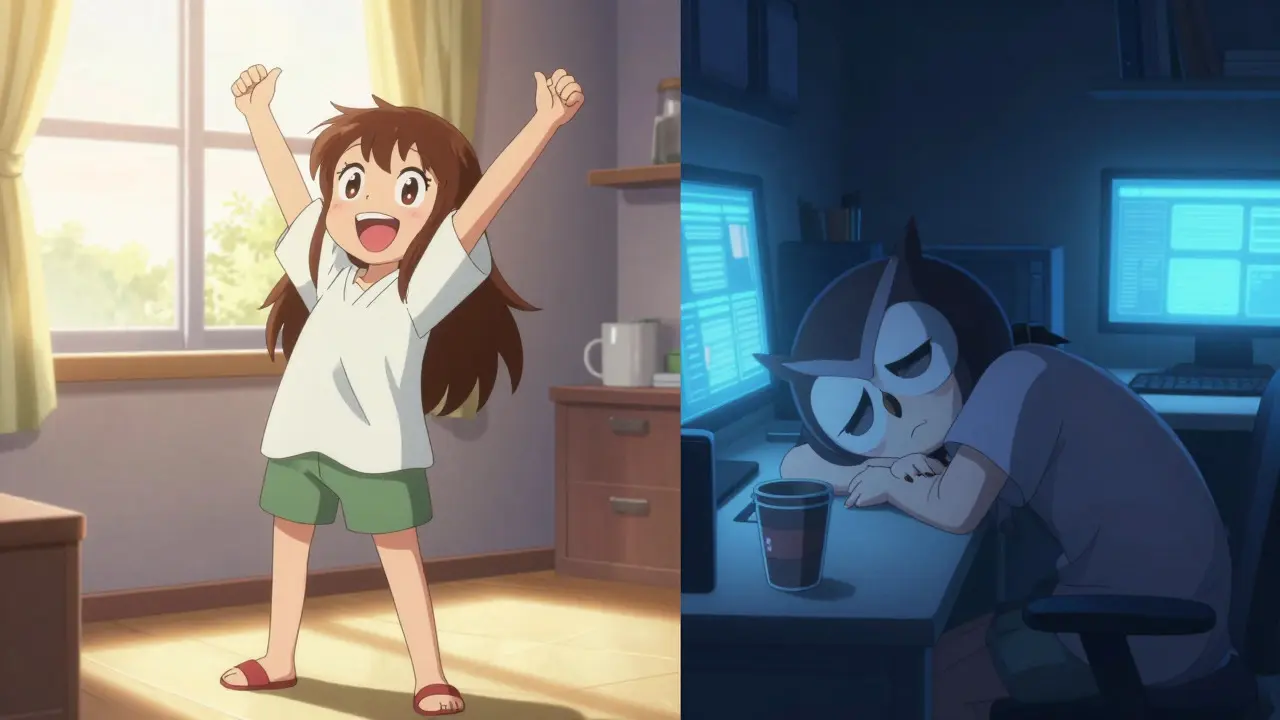
Have you ever tried to force yourself out of bed at 6:00 AM, only to feel like a zombie until noon? Or maybe you’re the person who hits the snooze button five times, knowing deep down that your brain doesn’t actually kick in until after breakfast. You aren’t lazy, and you definitely aren’t broken. You are just fighting your chronotype, which is your body’s natural preference for when to sleep and wake up.
We live in a world built for early risers-schools start at 8:00 AM, offices open at 9:00 AM, and grocery stores stock their fresh produce before dawn. But science tells us that this "one-size-fits-all" schedule ignores the biological reality of millions of people. Understanding whether you are a morning lark, a night owl, or something in between isn't just about vanity metrics on a sleep app; it is about aligning your life with your biology to boost productivity, protect your mental health, and avoid chronic fatigue.
What Is Your Chronotype?
Your chronotype is determined by your internal circadian clock, a biological mechanism that regulates physical, mental, and behavioral changes in a daily cycle. Think of it as your personal time zone. Just as New York is three hours ahead of Los Angeles, some people’s bodies are biologically set to be alert earlier in the day than others.
The concept gained scientific traction in the 1970s, but it was Till Roenneberg’s development of the Munich ChronoType Questionnaire (MCTQ) in the early 2000s that gave us a standardized way to measure it. The MCTQ calculates your chronotype based on your sleep midpoint during free days-when you don’t have an alarm clock forcing you up.
Here is how the population breaks down, according to data analyzed by Gretchen Rubin in 2023:
- Morning Larks: About 40% of people. They naturally wake up early and feel most energetic in the morning.
- Night Owls: About 30% of people. They prefer staying up late and feel sluggish in the early morning.
- Intermediate/Hums: The remaining 30%. They fall somewhere in the middle, adaptable but not extreme in either direction.
This distribution creates a bell curve. Most people sleep between 11:30 PM/midnight and 7:30/8:00 AM. However, there is nearly a 12-hour gap between the most extreme larks and the most extreme owls. This isn't a choice; it's largely genetic. A 2001 study from the University of Utah identified specific genetic mutations responsible for Familial Advanced Sleep Phase Syndrome, causing some individuals to wake up around 4:30 AM consistently. If you’ve always been an early bird or a late-night thinker, thank your DNA.
The Lark vs. Owl Debate: Who Wins?
For years, society has held a bias toward morning larks. We associate early rising with discipline, success, and health. And historically, the data seemed to support this. Larks generally report better sleep quality and consistency. According to SleepWatch App’s analysis of over 10,000 users in 2022, larks get an average of 48 more minutes of sleep per night than owls and are 40% more likely to say they wake up feeling rested. Early sleepers are also 75% more likely to be female, suggesting potential hormonal influences on timing.
However, the narrative is shifting. A groundbreaking 2023 study from Imperial College London challenged the idea that larks are cognitively superior. Among older adults, night owls actually performed better on cognitive tests than morning larks. Dr. West, a researcher involved in the study, noted that while younger morning types often show better health outcomes, this relationship may flip as we age. This suggests that being a night owl isn’t inherently "worse"-it’s just different.
So, why do owls seem to struggle so much more in modern society? It comes down to what Professor Till Roenneberg calls social jet lag, a the mismatch between our internal biological clock and the external social clock imposed by work and school schedules. When a night owl is forced to wake up at 7:00 AM for a job, their body thinks it’s still nighttime. This chronic misalignment leads to significant health disadvantages.
| Attribute | Morning Larks | Night Owls |
|---|---|---|
| Average Sleep Duration | Higher (approx. 48 mins more) | Lower |
| Sleep Consistency | High (7% greater rhythm stability) | Low |
| Cognitive Performance (Older Adults) | Lower | Higher |
| Health Risks | Lower risk of metabolic issues | Higher risk of obesity, diabetes, depression |
| Workplace Fit | High (aligns with 9-5) | Low (causes social jet lag) |
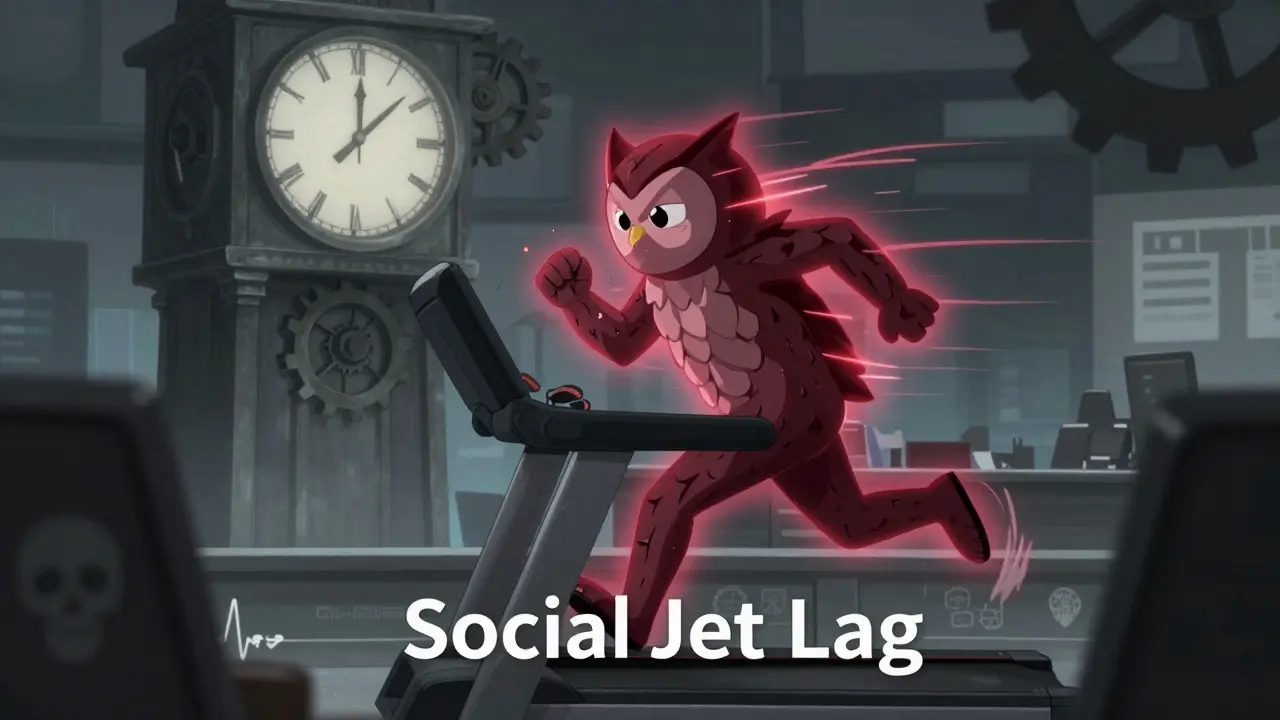
The Hidden Health Costs of Social Jet Lag
If you are a night owl trying to live a lark’s life, you are paying a heavy price. The health disparities are stark. A massive 2018 study involving over 430,000 people by researchers at the University of Surrey found that evening chronotypes faced a higher risk of mortality compared to morning types.
The reasons are multifaceted. Evening chronotypes suffer from higher rates of:
- Obesity: 27% higher incidence.
- Diabetes: 30% higher incidence.
- Metabolic Syndrome: 25% higher incidence.
- Depression: 29% higher incidence.
Why does this happen? It’s not just about willpower. It’s about timing. Baylor University’s Sleep Neuroscience and Cognition Laboratory found that evening-type college students who had to wake up early got significantly less sleep-averaging 6.2 hours versus 7.5 hours for morning types. This sleep deprivation forces them to rely on unhealthy coping mechanisms. In the same study, evening-types consumed caffeine an average of 2.7 hours later in the day (around 4:18 PM vs. 1:27 PM for larks) and spent 40 minutes more on social media in bed. These behaviors disrupt sleep further, creating a vicious cycle of poor rest and poor health.
Dr. Michael Scullin, director of the Baylor lab, explains that evening chronotypes show worse sleep quality despite facing similar academic stress. The problem isn’t the stress; it’s the schedule. When your body wants to sleep at 2:00 AM but your alarm rings at 6:00 AM, you are essentially running a marathon every single day.
Can You Change Your Chronotype?
Here is the good news: while genetics load the gun, environment pulls the trigger. Your chronotype is not entirely fixed. Baylor University’s 2023 research showed that 28% of students experienced measurable shifts in their chronotype over a single semester. Those who successfully shifted from evening to morning types saw their GPAs increase by an average of 0.45 points.
How do you make this shift? It requires hacking your light exposure and behavior. Dr. Kenneth Wright’s research at the University of Colorado Boulder demonstrated that electric light is the primary driver of our delayed sleep schedules. In one experiment, participants went camping without electricity for a week. Their sleep timing synchronized with the sun, and the differences between larks and owls nearly disappeared. Natural light is powerful.
To shift your chronotype earlier (if you want to be a lark), follow these steps:
- Morning Light Exposure: Get outside within 30 minutes of waking. Aim for at least 10,000 lux of light for 30 minutes. This signals your brain to stop producing melatonin and start the cortisol awakening response.
- Evening Darkness: Keep your bedroom pitch black (0-5 lux). Use blackout curtains or an eye mask. Blue light from screens suppresses melatonin, making it harder to fall asleep.
- Caffeine Cutoff: Stop consuming caffeine by 5:00 PM. Caffeine has a half-life of about 5-6 hours, meaning half of that 4:00 PM coffee is still in your system at 10:00 PM.
- Consistent Wake Time: Wake up at the same time every day, even on weekends. This anchors your circadian rhythm.
SleepWatch data shows that 68% of users who implemented three or more of these strategies achieved measurable chronotype shifts within one month. It takes patience-usually 2 to 4 weeks-to see real changes. Don’t expect overnight results.

Scheduling for Success: Practical Tips
You don’t always have the luxury of changing your job or school schedule. So, how do you work with what you have? The key is strategic scheduling. Match your most demanding tasks to your peak energy windows.
For Morning Larks:
- Schedule complex problem-solving, creative work, or important meetings in the morning (8:00 AM - 12:00 PM).
- Use the afternoon for administrative tasks, emails, and routine chores when your energy dips.
- Avoid heavy lunches that can cause a post-prandial slump.
For Night Owls:
- Protect your mornings. Use the first few hours for low-energy tasks like checking email or planning your day. Don’t try to do deep work at 8:00 AM if your brain isn’t ready.
- Shift your peak performance window to the late afternoon or early evening. Schedule your hardest tasks for 4:00 PM - 8:00 PM.
- If possible, negotiate flexible start times. A 2023 Gartner survey found that 42% of global organizations now offer flexible scheduling, partly due to chronotype awareness.
Remote work has been a game-changer here. Gallup’s March 2023 Workplace Survey revealed that 67% of remote-first companies implement flexible scheduling policies, compared to only 38% of office-based companies. If you are a night owl, remote work might be the best career move you can make to reduce social jet lag.
The Future of Work and Chronotypes
We are entering an era where ignoring chronotypes is seen as bad management. The market for "chronotype-friendly workplaces" is projected to grow at 14.3% annually through 2028. Companies like ChronoHealth are developing algorithms to personalize schedules based on individual rhythms. The RAND Corporation estimates that misaligned work schedules cost the US economy $411 billion annually in lost productivity. Aligning schedules could save billions.
However, challenges remain. Industries with fixed schedules-healthcare, manufacturing, transportation-still leave 78% of evening chronotypes experiencing significant social jet lag. For these workers, the focus must be on mitigation: optimizing sleep hygiene, using light therapy, and ensuring adequate rest periods between shifts.
Understanding your chronotype is the first step toward reclaiming your energy. Whether you are a lark, an owl, or somewhere in between, working with your biology rather than against it is the secret to sustainable success. Stop fighting the clock. Start understanding it.
Is being a night owl bad for your health?
Not inherently. Being a night owl is a natural biological variation. However, living in a society designed for morning people can lead to "social jet lag," which is associated with higher risks of obesity, diabetes, depression, and cardiovascular issues. The health risks come from the misalignment between your internal clock and your external schedule, not from being a night owl itself.
Can I change my chronotype from night owl to morning lark?
Yes, to some extent. While genetics play a major role, environmental factors like light exposure can shift your chronotype. Research shows that consistent morning light exposure, avoiding evening blue light, and maintaining a regular sleep schedule can shift your timing earlier over 2-4 weeks. However, extreme shifts may be difficult for those with strong genetic predispositions.
What is the best time for night owls to work?
Night owls typically experience their peak cognitive performance in the late afternoon or early evening, often between 4:00 PM and 8:00 PM. They should reserve their mornings for lower-intensity tasks like email and planning, saving their most demanding creative or analytical work for when their energy levels are highest.
How does light affect my chronotype?
Light is the primary cue for your circadian clock. Exposure to bright light, especially sunlight, in the morning suppresses melatonin and signals your body to wake up. Conversely, exposure to blue light from screens in the evening delays melatonin release, pushing your sleep time later. Managing light exposure is the most effective way to adjust your chronotype.
Are morning larks smarter than night owls?
No. Intelligence is not determined by chronotype. Recent studies, including one from Imperial College London in 2023, have shown that night owls can perform better on cognitive tests than morning larks, particularly among older adults. Previous beliefs that larks are smarter were likely influenced by societal biases and the fact that owls often suffer from sleep deprivation due to early start times.