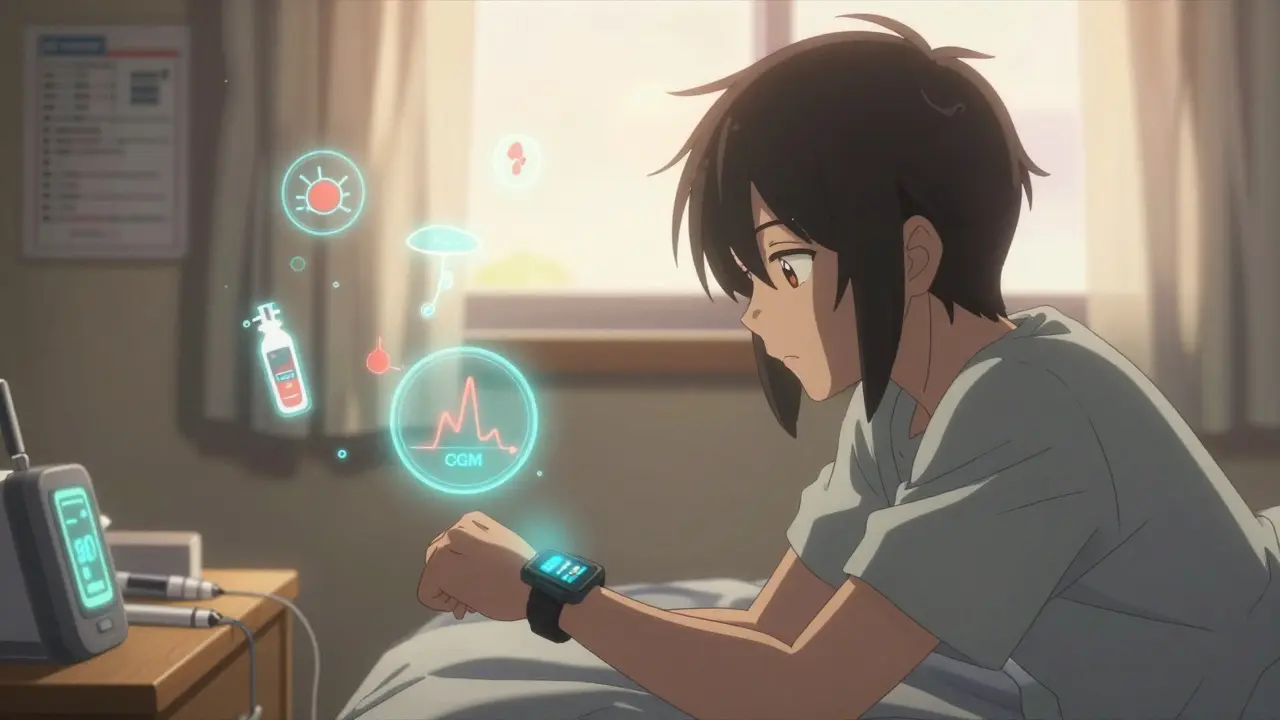
Every morning, you wake up to a blood sugar reading that’s way higher than it should be-even though you ate well the night before, took your meds, and didn’t snack before bed. If this happens regularly, you’re not failing at diabetes management. You’re experiencing the dawn phenomenon.
What Exactly Is the Dawn Phenomenon?
The dawn phenomenon isn’t a mistake. It’s biology. Between 3 a.m. and 8 a.m., your body naturally releases hormones like cortisol, growth hormone, and glucagon to prepare you for the day. These signals tell your liver to pump out glucose so you have energy to wake up. In people without diabetes, the pancreas responds by releasing just enough insulin to keep blood sugar steady. But if you have Type 1 or advanced Type 2 diabetes, your body either can’t make insulin or can’t use it well. So that extra glucose stays in your bloodstream-and your morning number climbs.This isn’t rare. About half of all people with Type 1 diabetes and half of those with Type 2 deal with it. It happens in kids, adults, and seniors. A 2020 study found 48.7% of children with Type 1 diabetes had noticeable morning spikes. It doesn’t care if you’re 12 or 72. It just happens.
Dawn Phenomenon vs. Somogyi Effect: Don’t Mix Them Up
Many people assume high morning blood sugar means they didn’t take enough insulin the night before. But that’s not always true. There’s another condition called the Somogyi effect-where low blood sugar overnight triggers a hormone surge that rebounds into high glucose by morning. The key difference? The Somogyi effect starts with a drop below 70 mg/dL. The dawn phenomenon doesn’t. It just rises steadily from 3 a.m. onward.How do you tell them apart? Check your blood sugar at 3 a.m. for three nights in a row. If it’s below 70 mg/dL, it’s likely Somogyi. If it’s above 100 mg/dL and climbing, it’s dawn phenomenon. Most people with morning highs (68% according to Medtronic’s analysis of 10,000 CGM records) actually have the dawn phenomenon-not a nighttime low.
Why It Matters: More Than Just a High Number
A single high morning reading might not seem like a big deal. But if it’s happening every day, it adds up. Persistent morning spikes can push your HbA1c up by 0.5 to 1.2 percentage points. That’s not small. Each 1% increase in HbA1c raises your risk of diabetes complications-like nerve damage, kidney problems, and vision loss-by 21%, according to the UK Prospective Diabetes Study.High morning glucose also makes you feel awful. You might be tired, thirsty, need to pee constantly, or feel blurry-eyed. In severe cases, especially with Type 1 diabetes, uncontrolled dawn phenomenon can lead to diabetic ketoacidosis (DKA). One 2023 study found people with unmanaged dawn phenomenon had 3.2 episodes of DKA per 100 patient-years. That’s a real danger.

How to Manage It: Practical Steps That Work
You can’t stop your body from making hormones in the early morning. But you can adjust how you respond to them. Here’s what actually helps, based on real data and clinical guidelines.1. Use Continuous Glucose Monitoring (CGM)
This isn’t optional anymore. If you’re still checking blood sugar with fingersticks only, you’re flying blind. CGMs show you the full picture: when your glucose starts rising, how fast, and whether it’s really dawn phenomenon. Trend arrows tell you if you’re heading up, down, or staying flat. Dexcom G7, Abbott FreeStyle Libre 3, and Medtronic Guardian 4 are the top tools. Eighty-five percent of endocrinologists now say CGM is essential for diagnosing and managing dawn phenomenon.2. Adjust Your Insulin (Especially If You Use a Pump)
If you’re on an insulin pump, you can program a temporary basal rate increase between 3 a.m. and 7 a.m. The T1D Exchange Registry found that 62% of users who did this reduced their morning glucose by 45-60 mg/dL. Automated insulin delivery systems like Control-IQ or t:slim X2 with Control-IQ 3.0 do this automatically. Clinical trials show they cut morning highs by 58-63% compared to older systems.3. Change Your Evening Meal
Carbs at night = more glucose in the morning. A 2021 study from Joslin Diabetes Center showed that limiting evening carbs to under 45 grams reduced morning spikes by 27%. Swap pasta or rice for more protein and healthy fats. Try grilled chicken with broccoli and olive oil instead of stir-fry with white rice. Avoid sugary desserts or fruit-heavy snacks before bed.4. Try a Smart Bedtime Snack
This sounds counterintuitive, but sometimes a small, low-carb snack helps. A mix of 15 grams of protein and 5 grams of fat-like a hard-boiled egg with a tablespoon of almond butter-can stabilize blood sugar overnight. Reddit users reported a 32% drop in morning highs after trying this. The idea is to prevent your liver from overcompensating by giving it a slow-burning fuel source.5. Optimize Your Sleep
Poor sleep makes dawn phenomenon worse. A 2022 review in Sleep Medicine Reviews found that getting less than 7 hours of sleep increased morning glucose by 15-20 mg/dL. Try to stick to a consistent bedtime. Avoid screens an hour before bed. If you have sleep apnea, get tested-it’s common in people with Type 2 diabetes and worsens insulin resistance.6. Talk to Your Doctor About Medication Timing
For Type 2 diabetes, some medications work better when taken at night. GLP-1 receptor agonists like semaglutide or liraglutide, when taken in the evening, have been shown to lower morning glucose by 18-22 mg/dL. Newer long-acting insulins like insulin icodec (once-weekly) are also showing better morning control in trials. Ask your provider if your current meds are timed optimally.What Doesn’t Work
Don’t just increase your nighttime insulin dose blindly. That’s how people end up with dangerous nighttime lows. A 2022 position statement from the American Association of Diabetes Educators found that 34% of patients who adjusted meds based only on morning readings ended up with more hypoglycemia. Always confirm the cause with overnight monitoring first.
Real People, Real Results
On diabetes forums, people who started using CGM said they finally understood what was happening. One user wrote: “I thought I was eating too much carbs at night. Turns out, my glucose was fine at midnight, then climbed 12 mg/dL per hour from 3 a.m. That’s dawn phenomenon. I adjusted my pump, and now I wake up under 130 most days.”Another shared: “I started having a spoonful of peanut butter with a boiled egg before bed. My morning highs dropped by half. My doctor didn’t believe me at first-until I showed the CGM graph.”
It’s not about perfection. It’s about patterns. If you’re waking up with numbers over 180 mg/dL five days a week, something needs to change. But you don’t need to overhaul everything at once. Start with one thing: get a CGM. Check your blood sugar at 3 a.m. for three nights. Then talk to your care team.
The Bigger Picture
The dawn phenomenon isn’t your fault. It’s not laziness, poor diet, or lack of willpower. It’s your body doing what it’s supposed to do-just without the right insulin support. That’s why experts like Dr. Robert Vigersky of Medtronic say it’s not a pathology. It’s a normal process that becomes problematic only in the context of diabetes.But ignoring it? That’s the problem. Dr. Anne Peters of USC calls it one of the top three reasons for uncontrolled HbA1c in patients who are otherwise doing everything right. The good news? We have better tools now than ever before. Automated insulin delivery, smarter meds, and CGMs are making dawn phenomenon manageable.
And the future? Researchers at Oxford have found seven genetic variants linked to stronger dawn responses. In five to seven years, we may be able to predict who’s at higher risk-and tailor treatments even more precisely.
What to Do Next
1. Check your blood sugar at 3 a.m. for three consecutive nights. Write down the numbers. 2. Review your CGM trend data. Look for a steady rise starting around 3 a.m. with no prior drop. 3. Try one change. Cut evening carbs, add a protein-fat snack, or adjust your basal rate if you use a pump. 4. Wait four to six weeks. Don’t rush. Give each change time to show results. 5. Bring your data to your provider. Don’t just say “my mornings are high.” Show the numbers. Show the graph. Ask: “Is this dawn phenomenon? What’s the next step?”Managing the dawn phenomenon isn’t about fighting your body. It’s about working with it. With the right tools and a little patience, you can wake up to numbers you feel good about-and start your day with more energy, less stress, and better control.