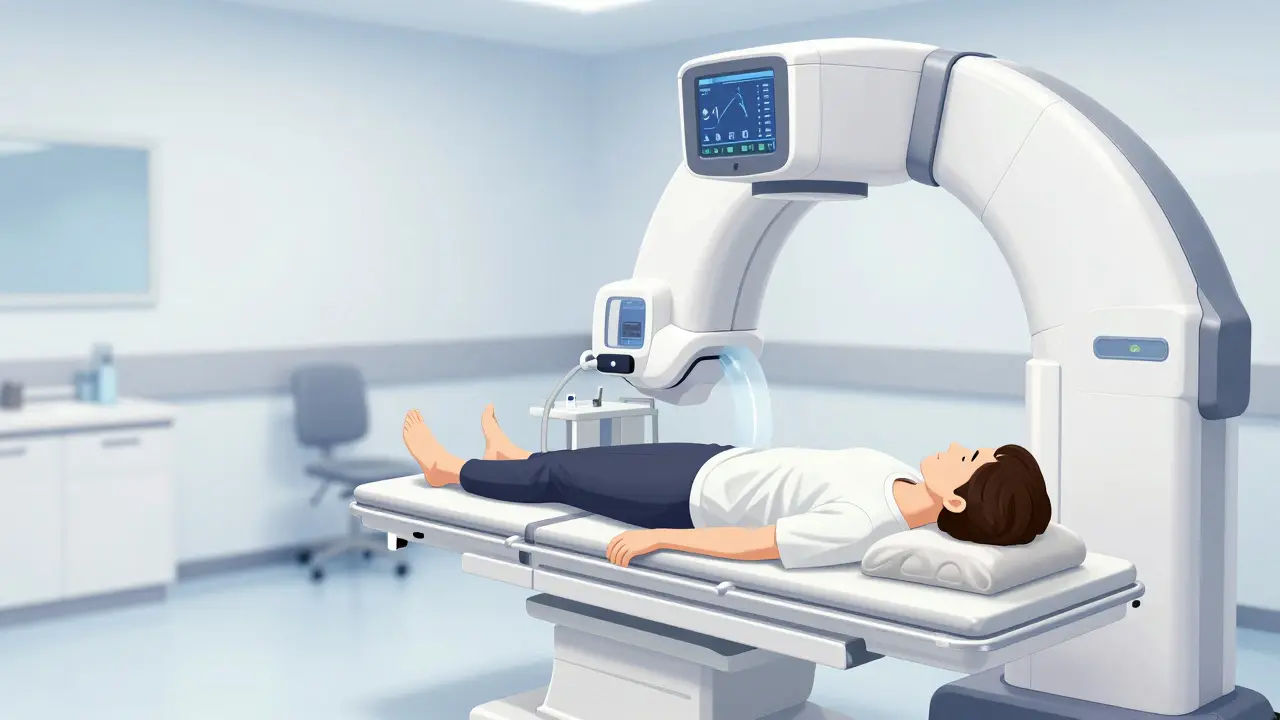
You might have just walked out of a clinic after a quick, painless scan, or maybe your doctor mentioned a bone density test during your last check-up. If you've ever wondered why a DEXA scan is the go-to method for checking your bones, or what on earth a "T-score" actually means for your future health, you're in the right place. Most people don't feel bone loss happening-it's often called a "silent disease"-so these scans are essentially your only early warning system before a fracture occurs.
Getting the results back can feel like reading a foreign language. You'll see numbers, decimals, and terms like "osteopenia" or "BMD." The good news is that these metrics provide a very clear roadmap for your healthcare provider to decide if you need medication, lifestyle changes, or just a follow-up in a few years. Let's break down exactly how this technology works and how to interpret the numbers on your report.
What Exactly is a DEXA Scan?
If you're unfamiliar with the term, DEXA is a non-invasive imaging test that measures bone mineral density (BMD) by passing two different X-ray beams through your bones. Also known as DXA, this technology is the global gold standard because it's incredibly precise and uses very little radiation-actually less than what you'd naturally absorb from the environment over two days.
During the process, you lie flat on a table while a C-arm scanner moves over you. It typically focuses on the lumbar spine and the hips, as these are the areas most prone to fractures. The machine differentiates between soft tissue and bone, calculating exactly how much mineral (mostly calcium) is packed into a specific area of your bone. The whole thing usually takes about 10 minutes, making it much faster and more comfortable than a full CT scan.
Decoding Your Results: T-Scores and Z-Scores
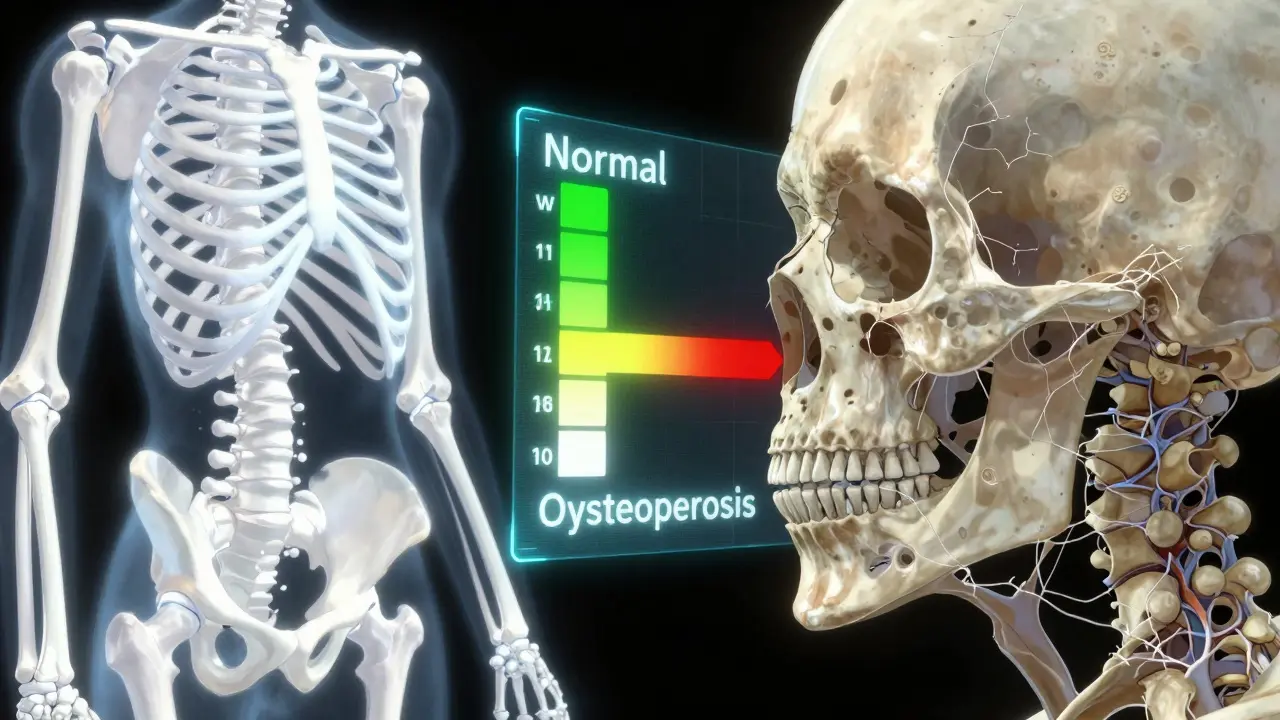
The most important part of your report is the T-score. This isn't a measurement of your bone mass in grams, but rather a comparison. A T-score tells you how many standard deviations your bone density is from that of a healthy 30-year-old (the peak bone mass age).
Here is the simple breakdown of how to read those numbers:
- Normal: A T-score of -1.0 or higher (e.g., 0, -0.5, or +1.2). Your bones are considered healthy.
- Osteopenia: A T-score between -1.0 and -2.5. This means your bone density is lower than normal, but not yet in the range of osteoporosis. Think of this as a "yellow light" warning.
- Osteoporosis: A T-score of -2.5 or lower. This indicates a significant loss of bone density and a higher risk of fractures.
You might also see a Z-score. While the T-score compares you to a "perfect" young adult, the Z-score compares your bone density to other people your own age and gender. If your Z-score is significantly low, your doctor might look for secondary causes of bone loss, such as thyroid issues or specific medications, rather than just natural aging.
| Category | T-Score Range | What it Means | Common Action |
|---|---|---|---|
| Normal | -1.0 or above | Healthy bone density | Routine monitoring |
| Osteopenia | -1.0 to -2.5 | Low bone mass | Diet, exercise, re-scan |
| Osteoporosis | -2.5 or below | Fragile bones | Medical intervention |
Beyond the Scan: Assessing Your Real Fracture Risk
Here is a critical point: a T-score doesn't tell the whole story. You could have a T-score in the osteopenia range but still be at high risk for a break due to other factors. Conversely, some people with osteoporosis don't fracture for years. This is why doctors use the FRAX tool a clinical algorithm developed by the World Health Organization to predict the 10-year probability of a major osteoporotic fracture.
FRAX combines your BMD from the DEXA scan with other "clinical risk factors." These include:
- Age and Gender: Risk naturally increases as we get older.
- Prior Fractures: If you've broken a bone recently from a minor fall, your risk is much higher.
- Parental History: A parent who suffered a hip fracture is a strong predictor of future risk.
- Lifestyle Factors: Smoking and high alcohol intake can weaken bone structure.
- Medications: Long-term use of corticosteroids (like prednisone) can strip minerals from your bones.
By plugging these into the FRAX tool, your doctor gets a percentage chance of you suffering a fracture in the next decade. This is often more useful for deciding on treatment than the T-score alone, especially for younger adults who might not fit the standard osteoporosis criteria but have high-risk profiles.
DEXA vs. Other Bone Tests
You might hear about other tests, like QCT scans or ultrasound. While they have their uses, they aren't replacements for a standard DEXA. For example, QCT (Quantitative Computed Tomography) provides a 3D volumetric measure of bone density. It's great for seeing the difference between the outer cortical bone and the inner spongy trabecular bone, but it comes with a much higher radiation dose-up to 8 mSv compared to the tiny 0.03 mSv of a DEXA.
Quantitative ultrasonography (QUS) is even lower in radiation (zero, actually), but it's usually only done on the heel or wrist. It's a good quick screening tool but isn't accurate enough to diagnose osteoporosis or track how well a medication is working. If you need a definitive answer on your bone health, DEXA remains the primary choice.
Common Pitfalls and Accuracy Issues
Not every scan is a perfect reflection of your health. There are a few things that can "trick" the machine and lead to an incorrect T-score. For instance, if you have severe arthritis or degenerative disc disease in your spine, the extra calcium deposits from bone spurs can make your bone density look *higher* than it actually is. This can lead to a false "normal" reading when you actually have osteoporosis.
Similarly, metallic implants from a prior hip or spinal surgery can interfere with the X-ray beams, creating artifacts that skew the results. If you've had surgery in the area being scanned, make sure to tell the technologist so they can adjust the region of interest or suggest a different site, like the forearm, to get an accurate reading.
The Future of Bone Screening
Bone health screening is moving toward a more detailed look at the *quality* of the bone, not just the *quantity*. One exciting development is the Trabecular Bone Score (TBS) an assessment of the bone's microarchitecture that works alongside a DEXA scan. While DEXA tells us how much mineral is there, TBS tells us how well that mineral is organized. A bone can have a decent density but a poor internal structure, making it brittle. Adding TBS to a scan can improve fracture prediction by up to 18%.
We're also seeing AI enter the room. New software can now analyze scans to detect tiny vertebral fractures that a human eye might miss, with sensitivity rates reaching over 94%. This allows for much earlier intervention in the "silent" phase of the disease.
How often should I get a DEXA scan?
For most people, a baseline scan is done at age 65 for women and 70 for men. However, if you have osteopenia, are taking bone-thinning medications, or have other risk factors, your doctor may suggest a scan every 2 years to track changes. There is no one-size-fits-all rule; it depends on your specific T-score and FRAX risk.
Is the radiation from a DEXA scan dangerous?
Not in any meaningful way. The radiation dose is extremely low-typically between 0.001 and 0.03 mSv. To put that in perspective, you get more radiation from a cross-country flight or simply living on Earth for a couple of days from natural background radiation than you do from a single DEXA scan.
Can I improve my T-score with diet and exercise?
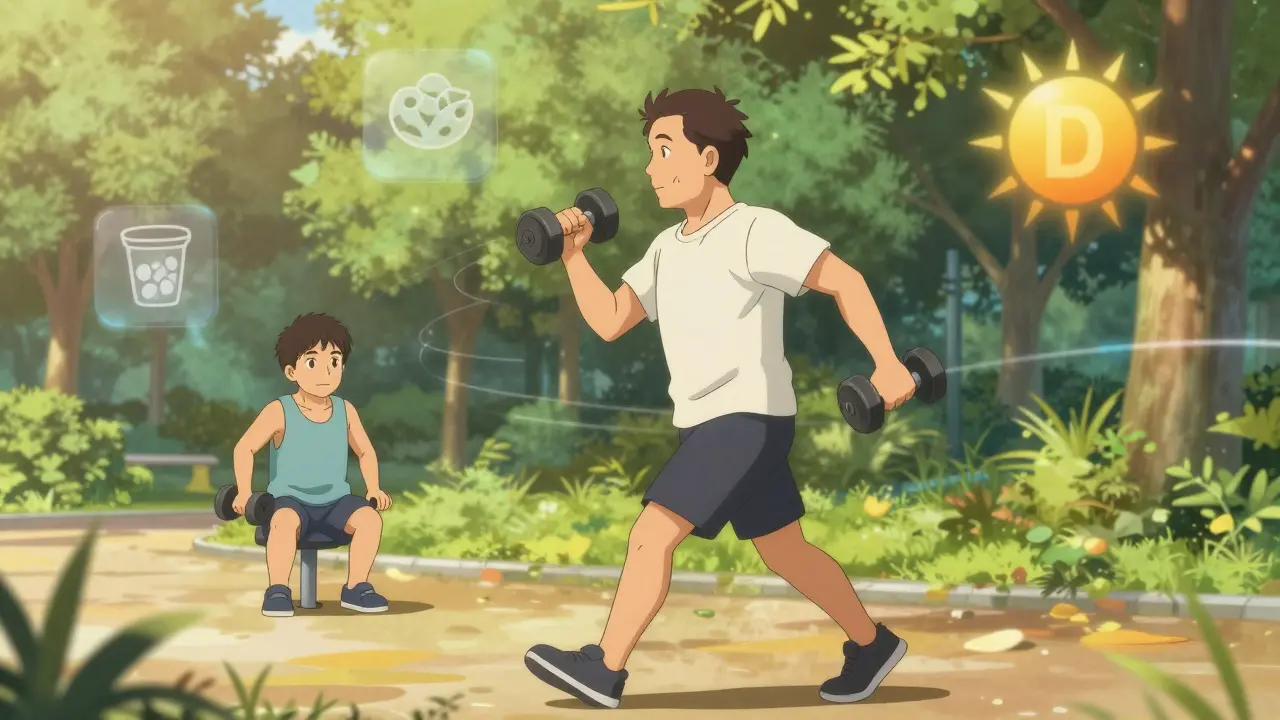
While you can't always "reverse" osteoporosis to a perfectly normal state, you can certainly slow the loss and potentially improve density. Weight-bearing exercises (like walking or weightlifting) and ensuring adequate intake of Calcium and Vitamin D are fundamental. For those with significant loss, these are used alongside medications like bisphosphonates.
What if my T-score is -1.5? Does that mean I'll definitely break a bone?
Not at all. A T-score of -1.5 places you in the osteopenia category, which means your bones are thinner than average. However, fracture risk depends on bone *quality*, your balance, your muscle strength, and your overall health. Many people with -1.5 never experience a fracture, while others with -1.0 might if they have very poor balance or a high fall risk.
Do I need to prepare anything for my appointment?
The most important thing is to wear comfortable clothing without metal zippers, snaps, or buttons, as these can interfere with the X-ray beams. You should also avoid taking calcium supplements within 24 hours of the scan, as the pill can sometimes appear in the scan area and skew the results.
Next Steps Based on Your Results
Depending on your results, your next move will vary. If you're in the Normal range, keep doing what you're doing-stay active and maintain a balanced diet. If you've been diagnosed with Osteopenia, now is the time to focus on "bone-loading" exercises and perhaps a Vitamin D supplement. It's a window of opportunity to prevent a full osteoporosis diagnosis.
If your results show Osteoporosis, don't panic, but do act. Your priority should be a detailed conversation with your doctor about pharmacological treatments. Because you can't feel your bones thinning, the T-score is your only objective way to know when it's time to move from "lifestyle changes" to "medical intervention." Pair your scan results with a FRAX assessment to get the most accurate picture of your health.