DIL Recovery Timeline Estimator
Recovery Timeline Calculator
Estimate how long it might take for your drug-induced lupus symptoms to improve after stopping the medication. Based on clinical data from published studies.
Estimated Recovery Timeline
Based on clinical data from the article:
- Symptoms Improvement
- Full Recovery
Note: These estimates are based on published studies showing most patients recover within these timeframes. Individual experiences may vary. Full recovery usually occurs within 12 weeks for most people.
When you take a medication to manage a chronic condition, you expect relief-not a new disease. But for some people, common drugs like hydralazine, procainamide, or even minocycline can trigger something called drug-induced lupus (DIL). It’s not the same as systemic lupus erythematosus (SLE), the more well-known autoimmune disease. DIL doesn’t usually attack your kidneys or brain. Instead, it mimics lupus symptoms in a way that’s often reversible. The good news? Most people fully recover once the drug is stopped. The bad news? It’s frequently missed or mistaken for something else.
What Does Drug-Induced Lupus Actually Feel Like?
If you’ve been on a medication for months and suddenly start feeling off, pay attention. DIL doesn’t hit all at once. It creeps in. The most common signs are muscle pain, joint swelling, and fatigue so deep it doesn’t go away with rest. About 80% to 90% of people with DIL report this kind of exhaustion. Fever shows up in more than half, and weight loss without trying isn’t unusual.
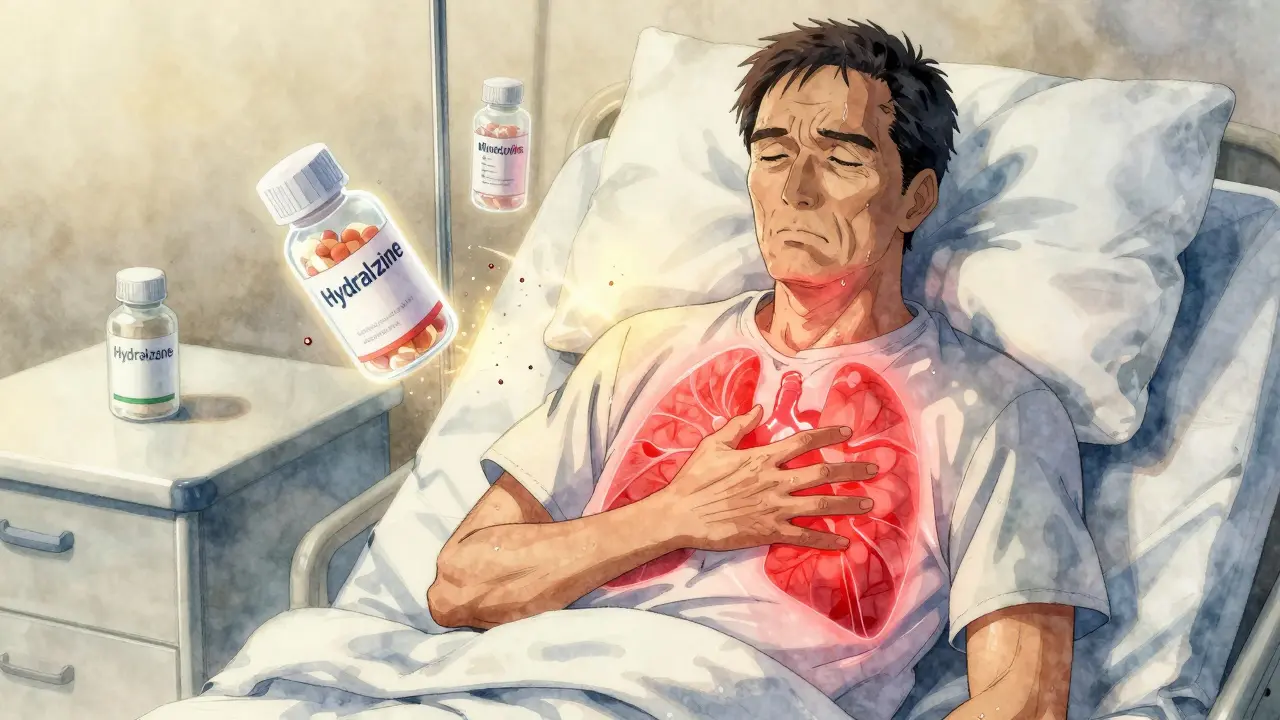
One of the clearest clues? Inflammation around the heart or lungs. About 1 in 3 people with DIL develop pleuritis or pericarditis. That means chest pain when you breathe deeply-a sharp, stabbing sensation that gets worse with movement. It’s not a heart attack, but it feels alarming enough to send you to the ER.
Unlike classic lupus, DIL rarely causes the butterfly-shaped rash across the cheeks. Only 10% to 15% of patients get that. Photosensitivity happens too, but less often-around 20% to 30% of cases. Skin rashes, if they appear, are usually milder and more like a sunburn than the classic lupus discoid lesions.
The big difference? Major organ damage. In SLE, kidney failure, seizures, or strokes can happen. In DIL? Less than 5% of patients have kidney involvement. Neurological problems? Under 3%. That’s why DIL is often called a "benign" form of lupus-not because it’s harmless, but because it doesn’t usually lead to life-threatening organ failure.
How Do Doctors Know It’s Drug-Induced?
There’s no single test for DIL. Diagnosis is a puzzle built from three pieces: your medication history, lab results, and how you respond after stopping the drug.
First, your doctor will ask: "What are you taking? How long have you been on it?" The timeline matters. DIL usually appears after 3 to 6 months of continuous use, but it can take as little as 3 weeks or as long as 2 years. The drugs with the highest risk are well-known: hydralazine (for high blood pressure), procainamide (for irregular heartbeat), and minocycline (an antibiotic for acne). TNF-alpha inhibitors like adalimumab, used for rheumatoid arthritis and Crohn’s disease, are now responsible for 12% to 15% of new cases-up from just 5% a decade ago.
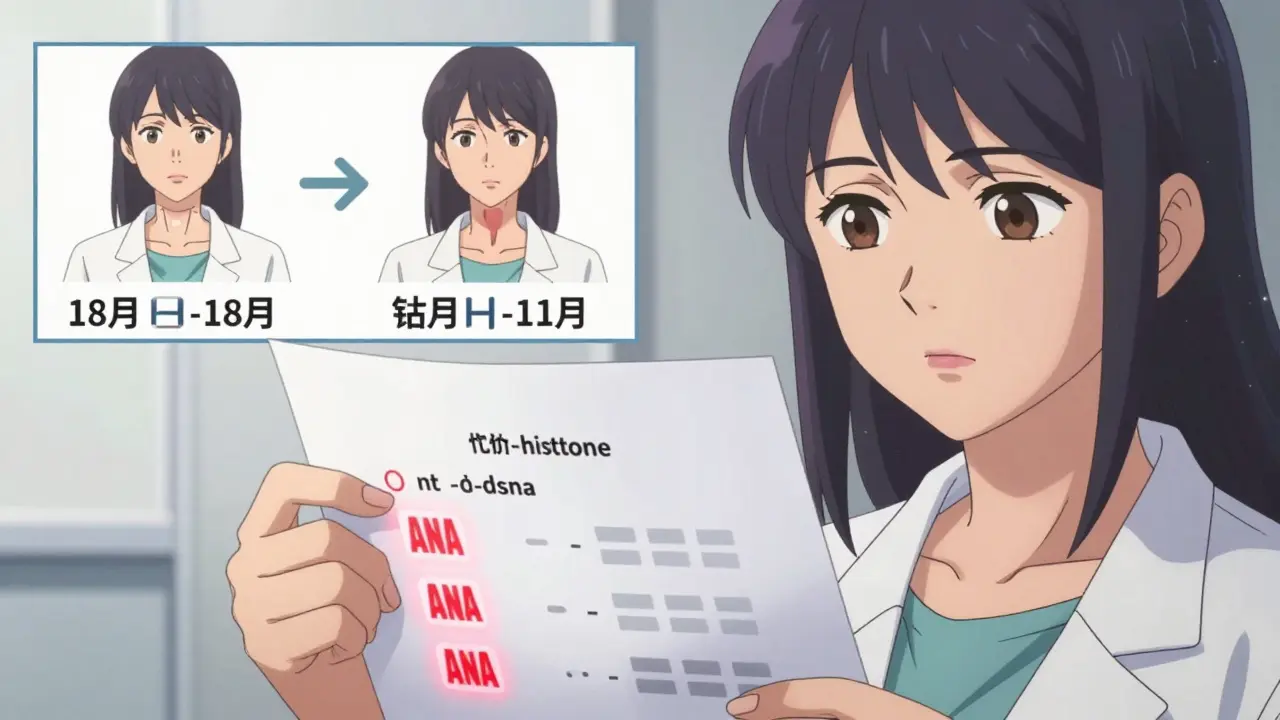
Lab tests help narrow it down. Over 95% of DIL patients test positive for antinuclear antibodies (ANA). But here’s the key: 75% to 90% have anti-histone antibodies. That’s a red flag. In classic SLE, only about half of patients have those. Meanwhile, anti-dsDNA antibodies-common in SLE-are found in fewer than 10% of DIL cases. If your ANA is positive but anti-dsDNA is negative, and you’ve been on hydralazine for a year? That’s a strong signal.
Other markers like ESR (erythrocyte sedimentation rate) and CRP (C-reactive protein) are often elevated, showing your body is in inflammation mode. But these aren’t specific. They just confirm something’s wrong.
The real diagnostic test? Stopping the drug. If symptoms start fading within 4 weeks and are gone in 12 weeks? You had DIL. No other test is as reliable.
Who’s Most at Risk?
DIL doesn’t care about gender like SLE does. While SLE hits women 9 times more often than men-especially between ages 15 and 45-DIL affects men and women equally. And it mostly hits older adults. About 70% to 80% of cases occur in people over 50.
But genetics play a role too. If you’re a "slow acetylator," your body processes certain drugs more slowly. That increases your risk. For hydralazine, slow acetylators have a 4.7-fold higher chance of developing DIL. That’s why some European guidelines now recommend testing for NAT2 gene variants before starting hydralazine. It’s not routine in the U.S. yet, but it’s coming.
HLA-DR4 positivity also raises risk. It’s not something you can change, but knowing you have it might help your doctor think twice before prescribing high-risk drugs.
Recovery: What Happens After You Stop the Drug?
Here’s the most important thing: DIL is usually temporary. Stop the drug, and your immune system usually resets itself.
Eighty percent of patients see major improvement within 4 weeks. For most, symptoms disappear completely within 8 to 12 weeks. A 2023 Reddit survey of 142 DIL patients showed 68% fully recovered without any treatment beyond stopping the medication. Only 22% needed short-term NSAIDs or low-dose steroids. A tiny 10% had lingering symptoms that lasted longer.
But stopping the drug isn’t always simple. If you’re on hydralazine for high blood pressure, your doctor can’t just say, "Stop it." They have to replace it with something safe-like an ACE inhibitor or calcium channel blocker. If you’re on procainamide for arrhythmia, switching to amiodarone reduces DIL risk from 30% down to 0.1%.
For mild symptoms, over-the-counter NSAIDs like ibuprofen help. If joint pain and fatigue persist, a short course of low-dose prednisone (5-10 mg daily for 4-8 weeks) usually clears things up. In rare cases, where symptoms are severe or don’t improve, doctors may use immunosuppressants like azathioprine or methotrexate-but this is uncommon.
Why Is DIL So Often Misdiagnosed?
Because it looks like other things. Fatigue, joint pain, fever-these are symptoms of fibromyalgia, chronic fatigue syndrome, even depression. A 2022 patient survey found that 55% of people with DIL were initially told they had one of those conditions. It took an average of 4.7 months to get the right diagnosis.
Doctors aren’t trained to think of DIL unless they’re rheumatologists. Primary care providers see hundreds of patients with joint pain every year. Most of them don’t have lupus. So when a 62-year-old man on hydralazine complains of achy joints, it’s easy to chalk it up to aging. The clue? The timing. If the pain started after 18 months on the same medication, that’s not aging. That’s a red flag.
One patient on HealthUnlocked shared: "I stopped minocycline for acne. My joint swelling vanished in three weeks. My dermatologist didn’t even know this could happen." That’s the problem. Many prescribers still don’t connect the dots.

What About Newer Drugs? Are They Safe?
It’s not just old drugs anymore. Since 2015, immune checkpoint inhibitors-used in cancer treatment like pembrolizumab and nivolumab-have become a growing cause of DIL. They work by turning the immune system loose against tumors. Sometimes, they turn it loose against the body too. About 1.5% to 2% of cancer patients on these drugs develop lupus-like symptoms.
And as more people take multiple medications for aging-related conditions, the risk rises. Polypharmacy (taking 5+ drugs) is now common in older adults. Each drug is a potential trigger. The good news? Awareness is growing. The American College of Rheumatology updated its diagnostic criteria for DIL in March 2023 to include medication timelines and antibody patterns more clearly. Research is also underway to find blood biomarkers-like specific microRNA profiles-that could predict who’s at risk before symptoms even start.
What Should You Do If You Suspect DIL?
If you’ve been on a medication for over 3 months and now have unexplained joint pain, fatigue, or chest pain when breathing-don’t ignore it. Don’t assume it’s just aging or stress.
Write down every drug you’re taking, including supplements and over-the-counter meds. Note when you started each one. Track your symptoms: when they started, what makes them better or worse. Bring this to your doctor. Ask: "Could this be drug-induced lupus?"
Request an ANA test and specifically ask for anti-histone antibody testing. If those are positive and anti-dsDNA is negative, your doctor should consider DIL. If you’re on hydralazine, procainamide, minocycline, or a TNF inhibitor, that’s even more reason to investigate.
Don’t stop your medication on your own. Work with your doctor to safely switch to a safer alternative. Then give it time. Most people feel better within weeks. Full recovery is the norm, not the exception.
Final Thought: It’s Not Lupus. It’s a Reaction.
Drug-induced lupus isn’t a life sentence. It’s a mistake your body made because of a drug. Once you remove the trigger, your immune system usually returns to normal. The challenge isn’t treatment-it’s recognition. Too many people suffer for months because no one connects the dots between their pills and their pain. If you’re on a high-risk medication and feel different, speak up. Your health isn’t just about managing one condition. It’s about protecting your whole body from unintended side effects.
Can drug-induced lupus turn into regular lupus?
No. Drug-induced lupus (DIL) does not progress into systemic lupus erythematosus (SLE). They are separate conditions. DIL is caused by a medication and resolves when the drug is stopped. SLE is a chronic autoimmune disease with genetic and environmental triggers. While the symptoms overlap, the underlying mechanisms are different. Once DIL clears, there’s no increased risk of developing SLE later.
How long does it take for symptoms to go away after stopping the drug?
Most people see improvement within 2 to 4 weeks after stopping the medication. About 80% of patients have significant relief by 4 weeks, and 95% recover fully within 12 weeks. In rare cases, symptoms may linger for up to 6 months, especially if the drug was taken for years or if the person has other autoimmune tendencies. But complete resolution is the rule, not the exception.
Are there any long-term effects of drug-induced lupus?
In the vast majority of cases, there are no long-term effects. Once the drug is stopped and symptoms resolve, the immune system returns to normal. Some people may have lingering positive ANA tests for months or even years, but that doesn’t mean the disease is still active. As long as symptoms are gone and no new ones appear, there’s no need for ongoing treatment or monitoring beyond routine care.
Which medications are most likely to cause drug-induced lupus?
The top three are hydralazine (for high blood pressure), procainamide (for heart rhythm problems), and minocycline (an antibiotic for acne). TNF-alpha inhibitors like adalimumab and infliximab are now a growing cause, especially in people with autoimmune conditions. Other less common triggers include isoniazid, methyldopa, and certain immune checkpoint inhibitors used in cancer therapy. The risk varies widely: procainamide can cause DIL in up to 30% of long-term users, while minocycline causes it in about 1% to 3%.
Is drug-induced lupus more common in older adults?
Yes. About 70% to 80% of DIL cases occur in people over 50. This is partly because older adults are more likely to be on long-term medications like hydralazine or minocycline, and partly because aging affects how the immune system responds to drugs. Unlike classic lupus, which peaks in young women, DIL affects men and women equally and is strongly tied to medication exposure over time.