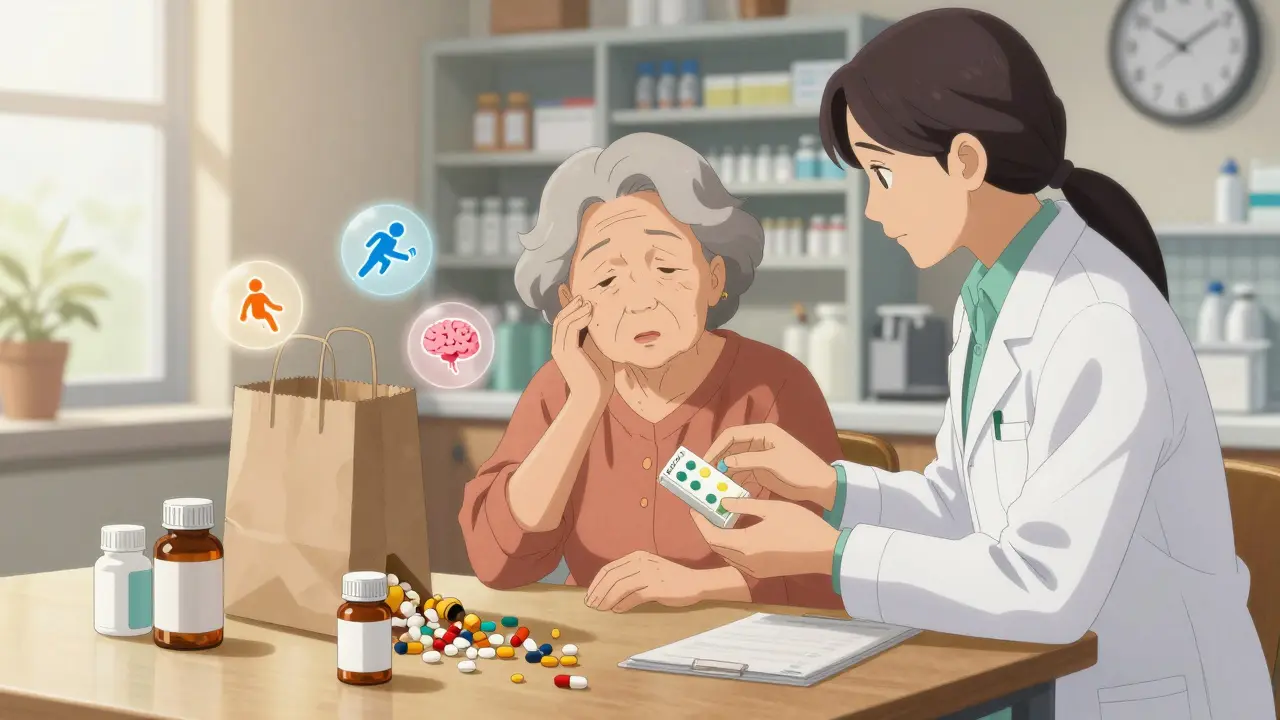
When an older adult takes five or more medications regularly, that’s called polypharmacy. It’s not rare-it’s common. Nearly 4 in 10 seniors in the U.S. are on this many drugs. Some need them. Others don’t. But too often, no one stops to ask: Do you still need all of these?
Why Polypharmacy Is More Dangerous Than It Looks
It’s not just the number of pills. It’s what happens when those pills interact with each other and with an aging body. As people get older, their liver and kidneys don’t process drugs the same way. By age 80, the liver may break down medications 30% to 50% slower than it did at 40. Kidneys clear drugs out at about 1% less efficiency every year after 40. That means drugs stick around longer, building up to dangerous levels-even at normal doses.
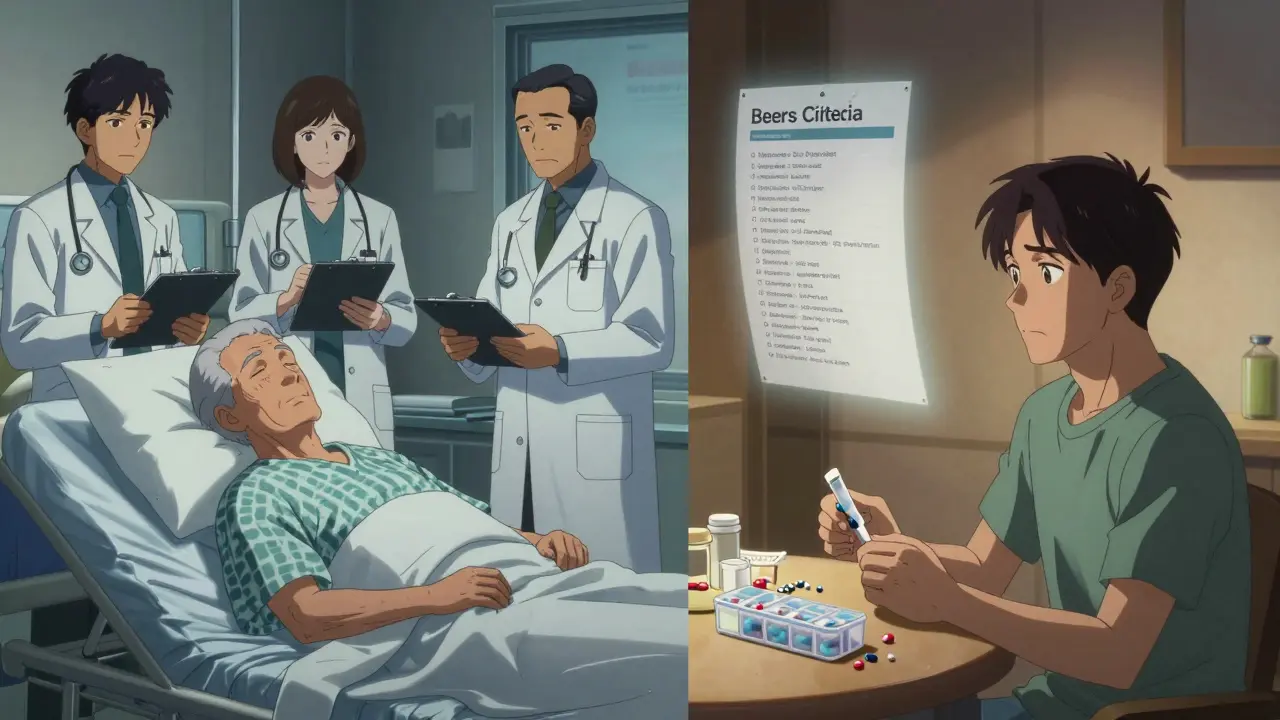
One study found that 35% of emergency room visits by seniors are linked to medication problems. Falls, confusion, internal bleeding, and delirium are all common signs that something’s wrong with the drug list. The American Geriatrics Society’s Beers Criteria lists 56 medications that are risky for older adults. Benzodiazepines? They double the chance of a fall. NSAIDs like ibuprofen? They raise stomach bleeding risk by 2.5 times. Anticholinergics-often used for overactive bladder or allergies? Linked to a 50% higher dementia risk over seven years.
The Hidden Problem: Medication Accumulation
Most seniors don’t start out on 10 pills. They get one for high blood pressure, then another for diabetes, then a third for arthritis, then a fourth for sleep, then a fifth for heartburn. Each visit to a different specialist adds another script. No one steps back to look at the whole picture.
Dr. Gurvich from UCI Health saw a patient who ended up with three times as many medications as he actually needed. Why? Because no one ever sat down with him and said, “Let’s go through everything you’re taking and see what’s still useful.” That’s the norm, not the exception.
When patients move from hospital to home-or from home to a nursing facility-medication lists get lost, copied, or ignored. Half of all post-discharge complications come from poor medication reconciliation. That means someone forgot to remove an old drug, added a duplicate, or didn’t explain why a new one was needed.
Who’s Most at Risk?
Women over 65 are more likely than men to be on multiple medications-44% vs. 24%. People in long-term care facilities are even more affected: up to 91% of residents take five or more daily drugs. But it’s not just about where they live. It’s about how many doctors they see. Nearly half of seniors on multiple meds get prescriptions from three or more different specialists. Each one focuses on one condition. Few ask: What does this all add up to?
Cost is another silent crisis. One in four seniors skips doses because they can’t afford their meds. And confusion? Only 55% of older adults can correctly say why they’re taking each of their pills. Imagine trying to remember whether that blue pill is for blood pressure or memory, and whether you’re supposed to take it with food or on an empty stomach. That’s daily life for many.
What Works: The Real Solutions
Managing polypharmacy isn’t about cutting pills randomly. It’s about deprescribing-a planned, thoughtful process of stopping drugs that do more harm than good.
Here’s what actually helps:
- Do a brown bag review. Ask the patient to bring every pill, capsule, vitamin, and supplement they take-even the ones from the corner store. In practice, this uncovers 2.8 unnecessary or duplicate medications per person.
- Use STOPP/START criteria. These are clinical tools that help identify inappropriate medications (STOPP) and missing ones that should be added (START). On average, older adults have 3.2 potentially inappropriate drugs on their list.
- Involve a pharmacist. Pharmacist-led medication reviews cut hospital readmissions by 24% in Medicare patients. They spot interactions doctors miss.
- Set clear goals. Instead of treating every number on a lab report, ask: What matters most to you right now? Is it staying independent? Avoiding falls? Sleeping through the night? Those goals should guide what stays and what goes.
- Review at every transition. Every time a patient moves-hospital to home, clinic to nursing home, ER to discharge-a full medication check should happen. Done right, this cuts errors by 40%.
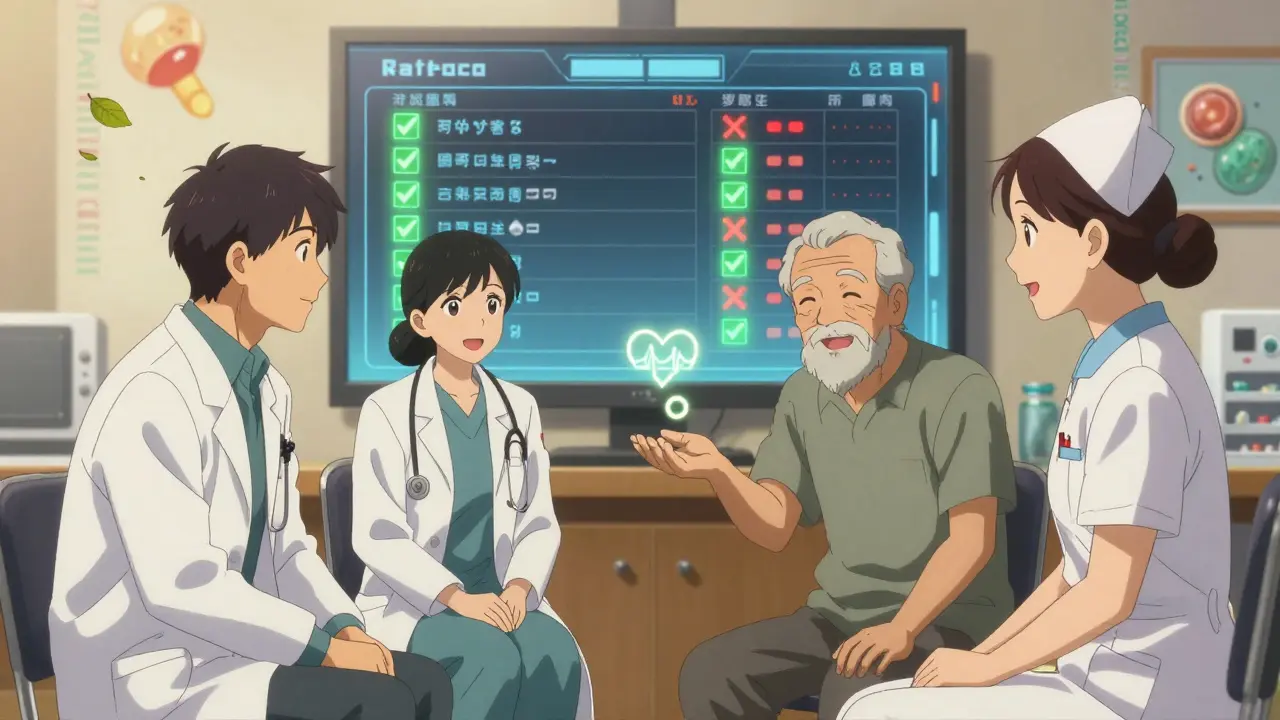
Teams that include doctors, pharmacists, and nurses are 32% more effective at optimizing medication lists than solo practitioners. This isn’t a one-person job.
What’s New in 2026
The 2023 update to the Beers Criteria added clearer guidance on stopping antipsychotics in dementia patients. Research shows that when these are carefully discontinued, mortality risk drops by 19%. Proton pump inhibitors (PPIs) for heartburn? Long-term use increases fracture risk by 26%. Many seniors take them for years without reassessment.
New tools are helping too. The FDA-approved MedWise platform uses genetic data to predict how a person’s body will react to specific drugs. In a 2022 trial, it cut adverse events by 41%. The Centers for Medicare & Medicaid Services launched a $15 million initiative in early 2023 to help 15 health systems build standardized deprescribing programs.
And the future? It’s moving away from counting pills toward measuring appropriateness. The National Institute on Aging is funding 12 major studies through 2025 to create personalized medication plans based on biological aging-not just age. Geropharmacogenomics, which looks at how genes affect drug response in older adults, could reduce bad reactions by half in people who get their DNA tested.
What You Can Do Right Now
If you’re caring for an older adult-or if you’re one-here’s what to do:
- Ask for a full medication review at least once a year. Don’t wait for a crisis.
- Bring all medications to every appointment. Include OTC drugs, supplements, and herbal remedies.
- Ask: “Is this still helping? Could it be hurting?”
- Don’t be afraid to say: “Can we try stopping this one?”
- Use a pill organizer-but only after confirming each pill is still needed.
- Speak up if you’re skipping doses because of cost. There are often cheaper alternatives or assistance programs.
Medications aren’t always the answer. Sometimes, the best treatment is taking one away.