
If you’re skipping doses because your medication costs too much, you’re not alone. Nearly 3 in 10 Americans say they can’t afford their prescriptions. But there’s a proven way to cut those costs without giving up your treatment: asking for a therapeutic alternative. This isn’t about generics or coupons-it’s about switching to a different drug that works just as well, but costs a fraction of the price.
What Is a Therapeutic Alternative?
A therapeutic alternative is a different medication that treats the same condition as your current one, but isn’t the exact same chemical. For example, if you’re taking esomeprazole (Nexium) for acid reflux, your doctor might suggest switching to omeprazole. Both are proton pump inhibitors. Both reduce stomach acid. But omeprazole costs about $15 a month as a generic-while Nexium can run $365. That’s a 96% drop. This isn’t random guesswork. Doctors use clinical guidelines to pick alternatives with proven results. Studies show that for conditions like high blood pressure, diabetes, and depression, switching to a therapeutic alternative often works just as well-with no drop in effectiveness. The key is matching the drug class and dosing. A 2017 study at Vanderbilt found that when doctors used these swaps, patients saved $17.77 per month on average-without worse health outcomes.Why Your Doctor Might Hesitate
You might have asked your doctor before and been told, “This is what works for you.” That’s understandable. Many providers weren’t trained to think about cost when prescribing. Some worry that switching could cause side effects or reduce effectiveness. And honestly, they’re busy. They don’t always have time to check formularies or compare prices. But here’s the thing: most doctors are open to it-if you come prepared. A 2023 survey found that 43% of patients said their provider was initially resistant to switching. But when patients brought data-like a GoodRx printout showing the price difference-doctors agreed 68% of the time.How to Ask for a Lower-Cost Option
Start with this simple script: “I’m having trouble affording my medication. Are there any equally effective, lower-cost alternatives?” That’s it. No jargon. No pressure. Just a direct question. Then, do your homework before the appointment:- Check your current drug’s price on GoodRx. Look up the generic version and other drugs in the same class.
- See if your pharmacy offers a $4 list. Walmart, CVS, and Walgreens all have lists of common generics for $4 for a 30-day supply. Drugs like lisinopril, metformin, and atorvastatin are almost always on it.
- Look up manufacturer patient assistance programs. Companies like Pfizer, AbbVie, and Merck offer free or heavily discounted drugs for people under 400% of the federal poverty level. Sites like NeedyMeds and RxAssist list them all.
- Write down 1-2 alternatives you’ve found. For example: “Could I try generic gabapentin instead of Lyrica? I saw studies showing they’re equally effective for nerve pain.”
Real Examples of Big Savings
These aren’t hypotheticals. Real people have saved thousands:- Switching from Eliquis (apixaban) to warfarin saved one patient $450 a month. Warfarin costs about $10. The only catch? It needs regular blood tests.
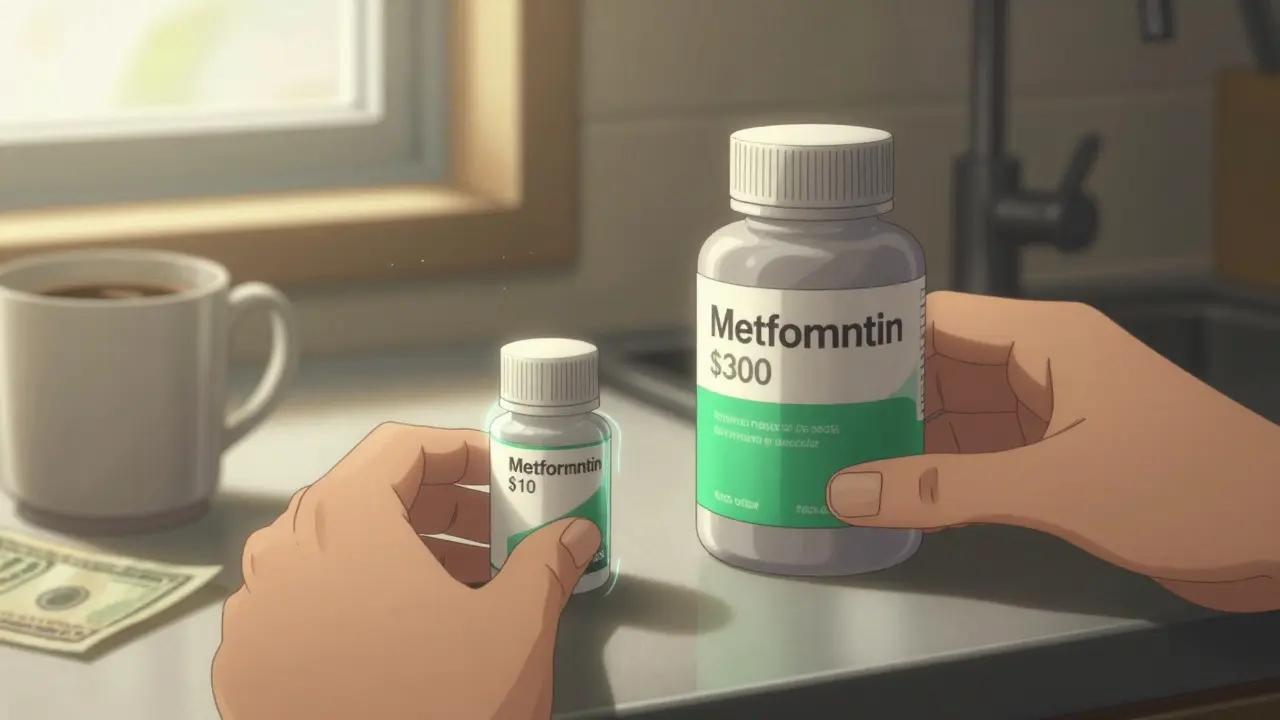
- A person on Jardiance (empagliflozin) for diabetes switched to metformin and dropped from $300/month to $10. Their blood sugar stayed stable.
- Someone taking Crestor (rosuvastatin) moved to generic atorvastatin and saved $380 a month. Their cholesterol numbers didn’t change.
What Doesn’t Work
Not every drug has a good alternative. This is especially true for biologics-drugs like Humira, Enbrel, or Taltz used for autoimmune diseases. These are complex, made from living cells, and there’s often no cheaper version that works the same way. About 15% of drug classes have no proven therapeutic alternatives. Also, don’t rely on coupons alone. A 2023 JAMA study found that 24% of prescriptions had patient copays higher than what the pharmacy gets paid by insurance. That means the coupon doesn’t help-the pharmacy loses money. These coupons only work if your insurance lets them apply.What to Do If Your Doctor Says No
If your doctor refuses, ask why. Is it because they don’t know the alternative? Or because they think it won’t work for you? If it’s the first, give them a printed summary from a trusted source like the Institute for Clinical Systems Improvement. They have free, condition-specific guidelines for therapeutic interchange. If they say it won’t work for your condition, ask for evidence. Can they show you a study proving your current drug is superior? Often, they can’t. Many drugs are prescribed out of habit, not data. You can also request a tiering exception through your insurance. If your plan has a high-cost drug on a higher tier (meaning you pay more), you can ask for it to be moved to a lower tier if a cheaper alternative isn’t appropriate. Medicare Part D must respond to these requests within 72 hours for urgent cases.
Long-Term Benefits
Saving $50 a month on a blood pressure pill might not sound like much. But over a year, that’s $600. Over five years? $3,000. And that’s just one drug. Most people take multiple prescriptions. When you add them up, therapeutic alternatives can mean the difference between paying for your meds-and paying for rent. Better yet, studies show that when people can afford their meds, they take them. That means fewer ER visits, fewer hospital stays, and better long-term health. One patient told Healthgrades they went from skipping doses 40% of the time to 100% adherence after switching to a cheaper alternative. That’s not just savings-it’s survival.Where to Find Help
You don’t have to do this alone:- GoodRx: Compares prices across 70,000+ pharmacies. Free to use.
- NeedyMeds: Lists patient assistance programs, discounts, and coupons for over 1,200 drugs.
- RxAssist: Run by the Partnership for Prescription Assistance, it’s a trusted, nonprofit database.
- HealthWell Foundation: Offers copay assistance for qualifying patients. They helped over 8,000 people in 2024.
Final Thought
Your health matters. But so does your wallet. You have the right to ask for care you can afford. Therapeutic alternatives aren’t a compromise-they’re a smart, science-backed way to get the same results at a fraction of the cost. Don’t wait until you can’t pay. Start the conversation today.Can I ask my pharmacist for a therapeutic alternative?
Pharmacists can tell you about cheaper options and help you compare prices, but they can’t switch your prescription without your doctor’s approval. They can, however, alert your doctor if a therapeutic alternative is available and suggest you discuss it. Always ask your pharmacist-they’re often the first to spot savings.
Are therapeutic alternatives safe?
Yes, when chosen properly. Therapeutic alternatives are selected based on clinical trials showing they’re equally effective and safe for the same condition. For example, switching from one statin to another for cholesterol has been studied in thousands of patients. But not all switches are right for everyone. If you have kidney disease, heart failure, or other complex conditions, your doctor will consider that. Always discuss your full medical history before switching.
Will my insurance cover the alternative?
Most likely. Therapeutic alternatives are usually generics or older drugs that are already on your plan’s preferred list. If the alternative isn’t covered, you can request a tiering exception. Medicare and most private insurers must review these requests within 14 days (72 hours for urgent cases). Your doctor will need to write a note explaining why the cheaper option won’t work for you.
What if the alternative doesn’t work?
It’s possible. About 8-12% of patients experience differences in how they respond to different drugs in the same class-especially with antidepressants or diabetes meds. If you switch and feel worse, contact your doctor right away. Most switches can be reversed quickly. Don’t stop the new drug suddenly without talking to your provider. Keep track of symptoms and share them with your doctor so they can adjust your treatment.
Can I use this for Medicare Part D?
Absolutely. Medicare Part D plans encourage therapeutic interchange to lower costs. In fact, CMS now requires all Part D plans to process tiering exceptions within 72 hours for urgent cases. If your drug is on a high tier, ask your doctor to submit a request for a lower-cost alternative. You can also use GoodRx to find the lowest cash price, even if you’re on Medicare.
How do I know if a drug is a true therapeutic alternative?
Look for drugs in the same class with matching indications. For example, all ACE inhibitors (like lisinopril, enalapril, benazepril) treat high blood pressure and heart failure similarly. The American College of Physicians and the Institute for Clinical Systems Improvement have published lists of approved therapeutic substitutions for common conditions. If you’re unsure, ask your doctor to check the FDA’s Orange Book or a clinical guideline.