
Hyperkalemia Risk Calculator
Assess Your Risk
This tool helps you understand your risk of hyperkalemia (dangerously high potassium) when taking trimethoprim. The calculator uses the key risk factors discussed in the article.
When you're prescribed an antibiotic like Bactrim or Septra, you're probably thinking about clearing up your infection-maybe a urinary tract infection or a sinus infection. But there's a hidden danger lurking in this common drug that many patients and even some doctors don't fully understand: trimethoprim can cause your potassium levels to spike dangerously high, sometimes within just a few days. This isn't a rare side effect. It's a well-documented, life-threatening risk that happens far more often than most people realize.
How Trimethoprim Plays Tricks on Your Kidneys
Trimethoprim is one half of the combination drug trimethoprim-sulfamethoxazole (TMP-SMX). It's been around since the 1970s and is still one of the most prescribed antibiotics in the U.S., with over 14 million prescriptions filled each year. But here's the twist: trimethoprim doesn't just kill bacteria. It acts almost exactly like a potassium-sparing diuretic, the kind of drug doctors use to treat high blood pressure or heart failure. Your kidneys control potassium levels by filtering it out of your blood and into your urine. To do that, they need a balance of sodium and electrical signals. Trimethoprim blocks sodium channels in the very last part of the kidney-the distal tubule. When sodium can't be reabsorbed, the electrical gradient that pushes potassium out of your blood and into your urine collapses. The result? Potassium builds up. And fast. Studies show that in healthy adults, trimethoprim can raise potassium levels by 0.5 to 1.5 mmol/L within 48 to 72 hours. That might sound small, but normal potassium ranges from 3.5 to 5.0 mmol/L. A jump to 6.0 or higher can trigger heart rhythm problems, muscle weakness, or even cardiac arrest.Who’s Most at Risk?
Not everyone who takes trimethoprim will have a problem. But certain people are walking into a minefield without knowing it.- People over 65-Kidney function naturally declines with age, and trimethoprim is cleared mostly by the kidneys. Slower clearance means higher drug levels and more potassium buildup.
- Those on ACE inhibitors or ARBs-Drugs like lisinopril, losartan, or valsartan are commonly prescribed for high blood pressure or diabetes. They also reduce potassium excretion. When combined with trimethoprim, the effect multiplies. One major study found these patients had a 6.7 times higher risk of hospitalization for hyperkalemia compared to those taking amoxicillin.
- People with chronic kidney disease-Even mild kidney impairment (eGFR below 60 mL/min) doubles the risk. If your eGFR is below 30, you should avoid trimethoprim entirely.
- Patients with diabetes-Diabetes often damages kidney function and alters how the body handles potassium. Combine that with trimethoprim, and the risk jumps to over 30% in some studies.
The Numbers Don’t Lie
The risk isn’t theoretical. It’s in the data.- Standard-dose TMP-SMX (for UTIs) causes hyperkalemia in about 8.4% of patients-compared to just 1.2% with other antibiotics.
- In patients with kidney disease, that number climbs to 17.6%.
- High-dose trimethoprim (used for pneumonia prevention in immunocompromised patients) leads to hyperkalemia in over 23% of cases.
- Between 2010 and 2020, the FDA recorded 1,247 cases of trimethoprim-induced hyperkalemia, including 43 deaths. Nearly 70% of those deaths were in people over 65.

Why Do Doctors Keep Prescribing It?
Trimethoprim-sulfamethoxazole is cheap, effective, and widely used. It’s still first-line for Pneumocystis pneumonia in HIV patients and for certain urinary and respiratory infections. But experts agree: it should be a last resort in high-risk groups. The American Geriatrics Society’s 2023 Beers Criteria says: “Avoid trimethoprim in adults over 65 who are on ACEIs or ARBs.” That’s a strong recommendation backed by solid evidence. Yet, a 2023 survey found that only 41.7% of primary care doctors check potassium levels before prescribing it. Emergency room doctors? Only 32.4%. Meanwhile, nephrologists check it almost every time-90% compliance. Why the gap? Because many doctors still think, “If the kidney test is normal, it’s fine.” But it’s not.What Should You Do?
If you’re prescribed trimethoprim, here’s what you need to know:- Ask if your potassium has been checked-Before the first dose. If it hasn’t, insist on a blood test.
- Get it checked again in 48-72 hours-That’s when potassium peaks. Don’t wait for symptoms.
- Know your baseline-If your potassium was already above 5.0 mmol/L, avoid trimethoprim. There are safer alternatives.
- Ask about alternatives-For urinary tract infections, nitrofurantoin or fosfomycin are just as effective and don’t raise potassium. For other infections, amoxicillin, doxycycline, or cephalexin are often better choices.
- Watch for warning signs-Muscle weakness, fatigue, irregular heartbeat, nausea, or tingling in your hands or feet. These can be early signs of high potassium.
What Happens If Potassium Gets Too High?
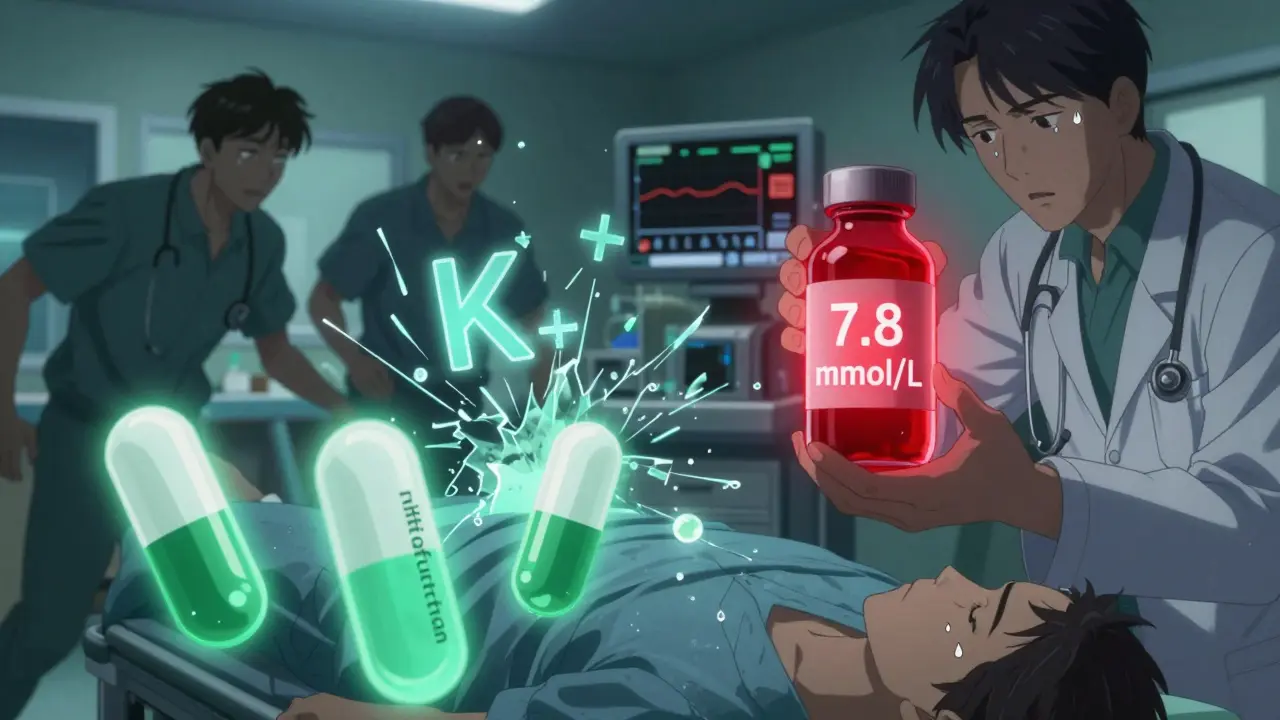
A potassium level above 6.0 mmol/L is a medical emergency. Symptoms can be subtle at first. But when potassium hits 7.0 or higher, your heart can stop beating without warning. Treatment isn’t simple. Doctors have to act fast:- Calcium gluconate-To protect the heart from arrhythmias.
- Insulin and glucose-To shift potassium back into cells.
- Beta-agonists (like albuterol)-To help cells take up potassium.
- Dialysis-If all else fails.
The Bottom Line
Trimethoprim isn’t evil. It saves lives. But it’s not harmless. It’s a silent potassium bomb in a pill bottle. For healthy, young people without kidney issues or blood pressure meds, the risk is low. But for older adults, diabetics, or anyone on ACEIs or ARBs, the danger is real-and preventable. The best defense? Awareness. Ask your doctor: “Is this the safest antibiotic for me?” Check your potassium before and after. Don’t assume normal kidney tests mean normal potassium. And if you’re on Bactrim and feel unusually tired, weak, or your heart feels off-get tested. Fast.It’s not about avoiding antibiotics. It’s about choosing the right one. And sometimes, the safest choice isn’t the most familiar one.
Can trimethoprim cause hyperkalemia even if my kidney function is normal?
Yes. Even people with normal creatinine and eGFR levels can develop dangerous hyperkalemia from trimethoprim. The drug concentrates in the kidney tubules at levels 10 to 50 times higher than in the bloodstream, so it directly interferes with potassium excretion regardless of overall kidney function. A 2023 case report documented a patient with normal kidney tests who developed a potassium level of 7.8 mmol/L after just three days of low-dose trimethoprim.
How soon after starting trimethoprim does potassium rise?
Potassium levels typically begin to rise within 24 hours and peak between 48 and 72 hours after starting the medication. In fact, 78% of severe cases (potassium above 6.0 mmol/L) occur within 72 hours. This is why checking potassium before and again after 72 hours is critical. Waiting for symptoms or relying on a single baseline test can be deadly.
Is nitrofurantoin safer than trimethoprim for urinary tract infections?
Yes, for patients at risk of hyperkalemia. Multiple studies, including a landmark 2014 JAMA Internal Medicine analysis, show nitrofurantoin carries no increased risk of hyperkalemia compared to placebo or other antibiotics. It’s recommended by the Infectious Diseases Society of America as a first-line alternative for UTIs in older adults, diabetics, or those on ACEIs/ARBs. It’s not perfect-it can cause lung or liver issues in rare cases-but its potassium risk is negligible.
Why don’t all doctors check potassium before prescribing trimethoprim?
Many still believe that normal kidney function (creatinine or eGFR) means low risk. But research shows potassium rises independently of these measures. A 2023 survey found only 41.7% of primary care doctors routinely check potassium before prescribing trimethoprim to patients on blood pressure meds. Emergency physicians are even less likely-just 32.4%. Lack of awareness, time pressure, and outdated assumptions contribute to this gap. Electronic alerts in electronic health records have cut hyperkalemia rates by over half when implemented.
What should I do if I’m already on trimethoprim and have high blood pressure medication?
Don’t stop the antibiotic abruptly unless you’re having symptoms like chest pain, irregular heartbeat, or extreme weakness. Contact your doctor immediately. Ask for a potassium blood test right away. If your potassium is above 5.5 mmol/L, your doctor should stop trimethoprim and switch you to a safer alternative like nitrofurantoin, fosfomycin, or amoxicillin. If it’s above 6.0 mmol/L, seek emergency care-this can be life-threatening.