
Imagine being told you can't take the most effective antibiotic because of an allergic reaction that happened years ago. You might have avoided it ever since, relying on weaker or more expensive alternatives. But what if that allergy label was wrong? For millions of people, a simple procedure called drug allergy skin testing is the key to removing that label and restoring access to safe, standard treatments.
This isn't just about convenience; it's about health. Incorrectly labeling someone as allergic to drugs like penicillin leads to the use of broader-spectrum antibiotics, which drives up healthcare costs and increases the risk of resistant bacteria. Skin testing offers a way to verify your immune system's response before you ever swallow a pill or receive an injection.
Why Do Doctors Recommend Skin Testing?
The primary goal of drug allergy skin testing is safety and precision. When you report an adverse reaction to a medication, doctors need to know if it was a true IgE-mediated allergy (an immediate immune response) or something else, like a side effect or intolerance. The American Academy of Allergy, Asthma & Immunology (AAAAI) considers skin testing the "gold standard" for investigating these immediate reactions.
Think of it as a controlled experiment. By introducing tiny amounts of the suspected drug into your skin, specialists can observe how your body reacts locally without exposing your entire system to the medication. This helps distinguish between a genuine life-threatening allergy and a minor rash or stomach upset. According to data from the Centers for Disease Control and Prevention (CDC), while 10% of the U.S. population reports a penicillin allergy, nearly 90% of those individuals can actually tolerate the drug when properly evaluated. Skin testing is the tool that makes this distinction possible.
The Three Main Types of Drug Allergy Tests
Not all drug reactions are created equal, so neither are the tests used to detect them. Specialists typically use three methods, often in combination, depending on the type of reaction you experienced and the specific drug in question.
- Skin Prick Test (SPT): This is usually the first step. A drop of the diluted drug solution is placed on your forearm or back. The clinician then uses a small lancet to gently prick the surface of the skin. It doesn't draw blood; it just allows a microscopic amount of the substance to enter the top layer of your epidermis. Results appear quickly, usually within 15 to 20 minutes. If you're allergic, a raised, itchy bump (called a wheal) will form at the site.
- Intradermal Test (IDT): If the prick test is negative but suspicion remains high, doctors may move to this method. Here, a very small needle injects a tiny amount (0.02-0.05 ml) of the drug directly into the dermis, the deeper layer of skin. This creates a small bleb or bubble under the skin. Because the drug is placed closer to the nerve endings and blood vessels, this test is more sensitive than the prick test but carries a slightly higher risk of a systemic reaction. It requires careful monitoring.
- Patch Test: This method is different from the other two. Instead of looking for immediate reactions, patch tests detect delayed hypersensitivity reactions, such as contact dermatitis or rashes that appear days after taking a drug. Small patches containing the drug are taped to your back for 48 hours. You'll return later for readings to see if a localized inflammation has developed.
Preparing for Your Appointment: Crucial Steps
Your preparation plays a massive role in the accuracy of the results. The most common reason for failed or inconclusive tests is improper pre-test medication management. Antihistamines-the drugs we take to stop itching and sneezing-work by blocking the very histamine release that causes the visible wheal during a skin test. If you've taken antihistamines recently, your skin won't react even if you are allergic, leading to a false-negative result.
You must avoid antihistamines for at least 5 to 7 days before your appointment. This includes over-the-counter cold medicines, sleep aids, and some antidepressants that have antihistaminic properties. Be honest with your doctor about everything you're taking. They may provide a list of approved medications you can use if you suffer from chronic allergies or asthma during this window.
Also, ensure you are not currently experiencing an active allergic reaction or suffering from severe, uncontrolled asthma. Skin testing is generally postponed until your condition is stable to minimize risks.
What Happens During the Procedure?
When you arrive, the specialist will review your medical history and the specific nature of your previous reaction. The actual testing process is relatively quick, usually taking 45 to 60 minutes in total, including waiting periods.
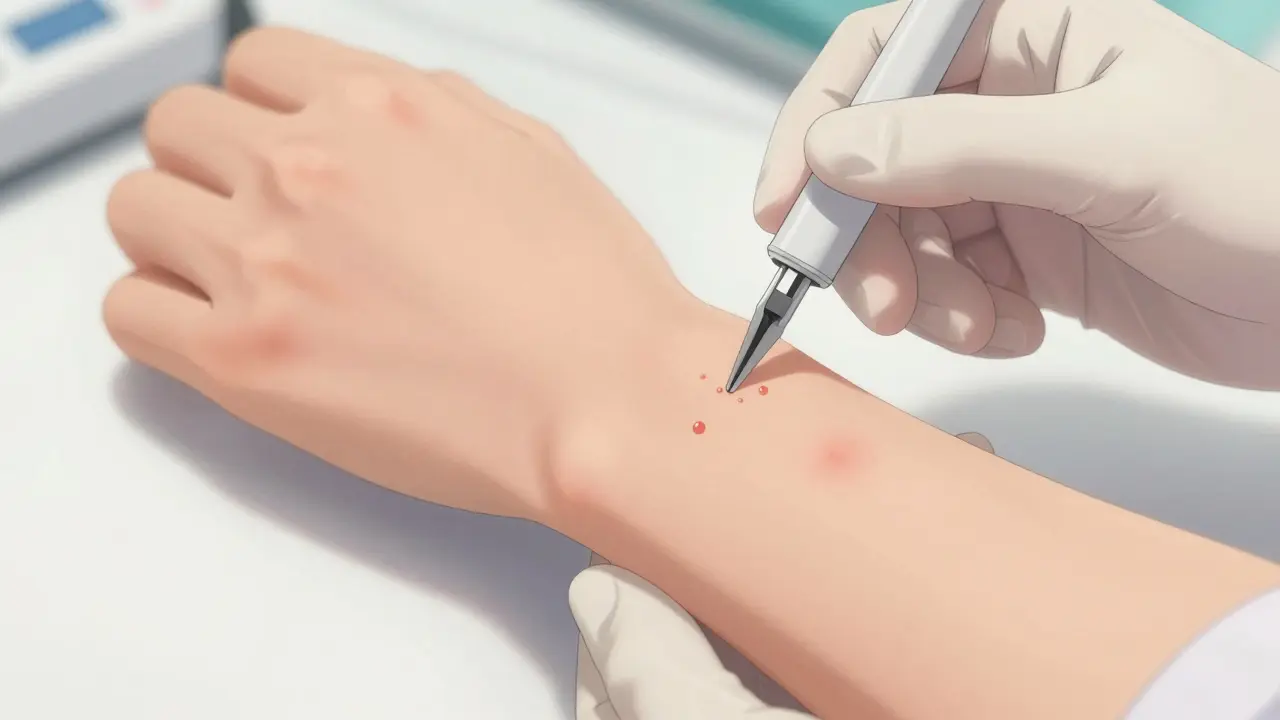
The clinician will clean the area on your arm or back and mark spots at least 2.5 cm apart using a permanent marker. They will apply the positive control (histamine) and negative control (saline) first. The histamine should cause a reaction in everyone; if it doesn't, the test is invalid because your skin isn't reacting properly (perhaps due to hidden antihistamine use). The saline should never cause a reaction.
Next, they apply the drug solutions. For the prick test, you'll feel tiny pinpricks, similar to mosquito bites. If the prick test is negative, they may proceed to the intradermal test. This involves a small needle stick, which feels like a brief sting. You'll wait 20 minutes between stages. During this time, you simply sit still. The clinician measures any resulting wheals with a ruler. A positive result is typically defined as a wheal that increases in diameter by 3 mm or more compared to the baseline.
It is normal to feel anxious, especially if you've had a bad reaction before. However, remember that the amount of drug used in skin testing is minuscule and stays largely in the top layers of the skin. It does not enter your bloodstream in significant quantities, meaning systemic "whole-body" symptoms are extremely rare when performed by trained professionals.
Interpreting Your Results: Positive vs. Negative
A positive result means your immune system recognizes the drug as a threat. In this case, you should avoid that specific medication and potentially related classes of drugs. Your doctor will document this clearly in your medical records.
A negative result is great news, but it requires context. For beta-lactam antibiotics like penicillin, a negative skin test has a very high negative predictive value (85-90%). This means if both the prick and intradermal tests are negative, you are highly unlikely to have an immediate IgE-mediated allergy. However, a negative test doesn't completely rule out all types of reactions, especially delayed ones or non-immune mediated side effects.
If the skin test is negative, your doctor may recommend a "drug challenge." This involves taking gradually increasing doses of the medication under strict medical supervision to confirm tolerance. This final step provides definitive proof that you can safely use the drug.
| Test Type | Method | Best For | Result Time | Sensitivity |
|---|---|---|---|---|
| Skin Prick Test (SPT) | Surface prick with lancet | Initial screening for immediate reactions | 15-20 minutes | Moderate |
| Intradermal Test (IDT) | Injection into dermis | Confirmatory test if SPT is negative | 20 minutes | High |
| Patch Test | Taped patches on back | Delayed reactions (rashes, dermatitis) | 48-96 hours | Variable |

Limits and Risks of Skin Testing
While valuable, skin testing isn't perfect. Its sensitivity varies significantly by drug class. It works exceptionally well for penicillins and cephalosporins but is much less reliable for drugs like sulfonamides, vancomycin, or NSAIDs. For many non-beta-lactam antibiotics, skin tests may only detect 30-50% of true allergies. This is why clinical history and sometimes drug challenges remain essential parts of the diagnostic puzzle.
There is a small risk of a severe allergic reaction (anaphylaxis) during the test, though this is rare when performed in a specialized clinic equipped with emergency medications like epinephrine. This is why guidelines from organizations like the British Society for Allergy and Clinical Immunology (BSACI) mandate that only trained healthcare providers perform these tests.
The Bigger Picture: Antibiotic Stewardship
Undergoing drug allergy skin testing contributes to a larger public health effort known as antimicrobial stewardship. When patients are incorrectly labeled as allergic to penicillin, doctors prescribe broader-spectrum antibiotics. These stronger drugs kill more types of bacteria, including beneficial ones, which can lead to complications like Clostridioides difficile (C. diff) infections. Studies show that hospitals with formal allergy testing programs see a 22% reduction in C. diff rates. By getting tested, you aren't just helping yourself; you're helping combat antibiotic resistance.
Does drug allergy skin testing hurt?
Most patients describe the skin prick test as feeling like tiny mosquito bites. The intradermal test involves a small needle injection, which causes a brief stinging sensation. Any itching from a positive reaction is manageable and temporary. The discomfort is minimal compared to the benefit of knowing your true allergy status.
How long do I need to avoid antihistamines before the test?
You should avoid antihistamines for at least 5 to 7 days prior to your appointment. Some older antihistamines require longer washout periods. Always consult your allergist for a specific list of medications to stop, as some prescription drugs also interfere with test results.
Can skin testing be done for any drug?
No. Skin testing is most accurate for beta-lactam antibiotics (penicillins, cephalosporins) and some anesthetics. It has limited utility for many other drug classes like NSAIDs, sulfa drugs, and vancomycin. For these, doctors may rely on clinical history or supervised drug challenges instead.
What happens if my skin test is positive?
A positive result confirms an IgE-mediated allergy. You will be advised to avoid the specific drug and potentially related medications. Your doctor will update your medical records and provide you with alternative treatment options that are safe for you.
Is a negative skin test guarantee that I'm not allergic?
For penicillin, a negative skin test combined with a negative intradermal test has a very high negative predictive value (over 90%), meaning it is highly likely you are not allergic. However, it does not rule out all types of reactions. Your doctor may recommend a supervised drug challenge to definitively prove tolerance.