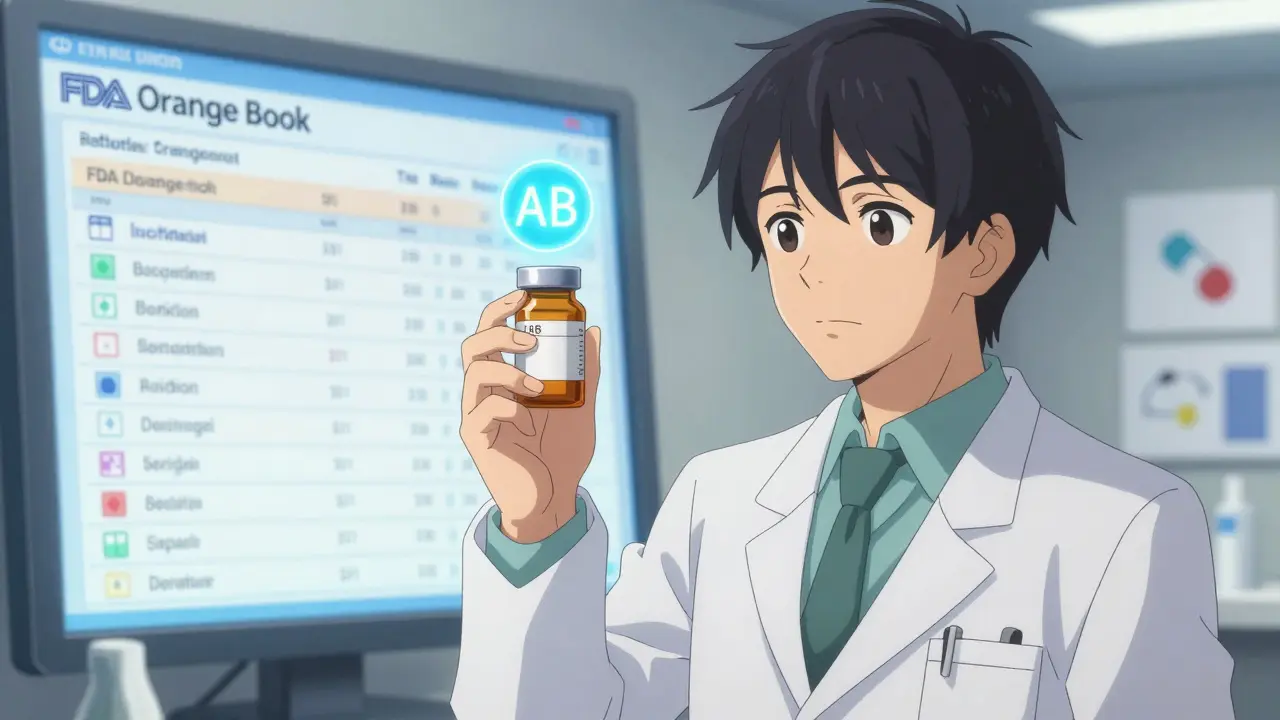
When a pharmacist hands you a generic pill instead of the brand-name version, how do you know it’s truly the same? The answer isn’t in the packaging or the price - it’s in the FDA Orange Book. This isn’t just a dusty reference guide. It’s the official, real-time database that tells pharmacists, doctors, and insurers whether a generic drug can legally and safely replace its brand-name counterpart. If you’re managing medications for yourself or someone else, understanding how to use this tool isn’t optional - it’s essential.
What the FDA Orange Book Actually Is
The FDA Orange Book, officially titled Approved Drug Products with Therapeutic Equivalence Evaluations, is the U.S. Food and Drug Administration’s public record of all approved prescription drugs and their generic equivalents. It started in 1980 but became the legal backbone of generic drug substitution after the Hatch-Waxman Act of 1984. That law created the system that lets generics enter the market faster - but only if they prove they work just like the original. It’s not a list of every drug on the market. It’s focused on prescription medications only. Over-the-counter (OTC) drugs like ibuprofen or antacids don’t appear here because they’re not subject to the same substitution rules. The database includes over 16,000 approved products, and it’s updated every single day. That means if a new generic hits the market or a patent expires, you’ll see it in the Orange Book within 24 hours. The key thing it tracks isn’t just the drug name - it’s whether the generic is therapeutically equivalent. That’s the technical term for: same active ingredient, same strength, same form (pill, injection, inhaler), and proven to work the same way in your body. If it meets all those standards, it gets a rating. And that rating is what you need to look for.The Two-Letter Code That Matters: AB, A, B, BX
Not all generics are created equal in the eyes of the FDA. That’s why they use a simple but powerful two-letter code: the Therapeutic Equivalence (TE) code. The most important code you’ll see is AB. If a generic drug has an AB rating, it means the FDA has confirmed it’s therapeutically equivalent to the brand-name drug. You can swap it without worry. AB1, AB2, AB3? Those just mean the generic matches one of several possible brand-name reference drugs for the same active ingredient. For example, if there are three different versions of levothyroxine on the market, each might have its own AB code - AB1 for Synthroid, AB2 for Levoxyl, etc. You need to match the code to the right reference drug. If you see just an A, that means the drug is a pharmaceutical equivalent - same ingredients, same dose - but the FDA hasn’t confirmed bioequivalence. That’s rare. Most A-rated drugs are outdated or lack sufficient data. A B rating is a red flag. It means the generic is not considered equivalent. This could be because it doesn’t absorb the same way in the body, or because the formulation causes inconsistent results. These are not approved for substitution. And then there’s BX. This is the sneaky one. BX means the FDA doesn’t have enough evidence to say it’s equivalent - but also doesn’t have proof it’s unsafe. These drugs are often complex, like inhalers, topical creams, or injectables where bioequivalence is harder to measure. Pharmacists can’t substitute these automatically, even if they’re cheaper.How to Search the Electronic Orange Book - Step by Step
The old paper version is gone. Today, you use the Electronic Orange Book - free, public, and updated daily. Here’s how to find what you need in under five minutes:- Go to accessdata.fda.gov/scripts/cder/ob/. Make sure you’re on the official site - no third-party sites.
- Under “Search by,” select Proprietary Name. Type in the brand-name drug - for example, “Lipitor.”
- Click “Search.” You’ll see a list of products. Look for the one marked as the Reference Listed Drug (RLD). That’s the original brand-name drug.
- Now scroll down. Below the RLD, you’ll see generic versions. Each will have a Therapeutic Equivalence Code in the last column.
- Look for AB. If you see AB, that generic is approved for substitution. If you see BX, B, or no code at all, it’s not approved.
What the Orange Book Doesn’t Tell You
The Orange Book is authoritative, but it’s not the whole story. It tells you what the FDA says about equivalence - not what your state or insurance company allows. For example, levothyroxine (used for thyroid conditions) has many AB-rated generics. But because it’s a narrow therapeutic index drug - meaning tiny differences in dose can cause serious side effects - many states require a doctor to specifically authorize substitution. The Orange Book doesn’t flag this. You need to check your state’s pharmacy board rules separately. Also, the Orange Book doesn’t track real-world performance. A generic might be AB-rated and legally substitutable, but some patients report feeling different when switching - especially with antidepressants, seizure meds, or heart medications. That’s not a flaw in the system; it’s a limitation. Bioequivalence is measured in healthy volunteers, not in people with complex health conditions. And don’t confuse patent expiration with market exclusivity. A drug might lose its patent, but still be protected by 180-day exclusivity granted to the first generic applicant. That means even if the Orange Book shows an AB-rated generic, it might not be on the market yet.Why This Matters for Real People
Imagine you’re on a fixed income and your insurance only covers generics. You switch from a brand-name drug to a generic with an AB rating - and your condition stays stable. That’s the system working. But if you switch to a BX-rated product because it’s cheaper, and your blood pressure spikes or your seizures return - that’s dangerous. The Orange Book exists to prevent that. Pharmacists use this tool every day. If you’re a caregiver, a patient managing multiple meds, or even a nurse or medical assistant, knowing how to read the TE code helps you ask better questions. Instead of accepting “this generic is fine,” you can ask: “What’s the TE code? Is it AB?” The FDA estimates that 90% of all prescriptions in the U.S. are filled with generics. That’s $635 billion in annual savings. But those savings only matter if the drugs are truly equivalent. The Orange Book is the gatekeeper of that trust.
Common Mistakes and How to Avoid Them
People often get tripped up. Here are the top three errors:- Mixing up OTC and prescription drugs. The Orange Book doesn’t rate OTC meds. If you’re looking up aspirin or Zyrtec, don’t expect a TE code.
- Assuming all generics with the same name are equal. Two different companies might make levothyroxine tablets. One might be AB1, another AB2. They’re not interchangeable unless they match the same RLD.
- Trusting third-party apps. Drugs.com, Medscape, and others pull data from the Orange Book - but they’re often 1-3 days behind. For critical decisions, always check the official FDA site.
What’s Next for the Orange Book
The FDA is moving toward machine-readable data. By 2024, the Orange Book will integrate with the Purple Book (for biologics) and use structured formats that allow pharmacies and EHR systems to auto-check equivalence in real time. In five years, most verifications will happen behind the scenes - your pharmacy system will flag a non-AB drug before it’s dispensed. But until then, the responsibility is still on you. Whether you’re a patient, a caregiver, or a healthcare worker, knowing how to read the Orange Book means you’re not just accepting what’s handed to you. You’re verifying it.What does an AB rating mean in the FDA Orange Book?
An AB rating means the FDA has determined the generic drug is therapeutically equivalent to the brand-name reference drug. It has the same active ingredient, strength, dosage form, and route of administration, and has been proven to work the same way in the body. Pharmacists can legally substitute an AB-rated generic without needing a new prescription.
Can I trust generic drugs with an AB rating?
Yes. AB-rated generics must meet the same strict standards as brand-name drugs for safety, effectiveness, and manufacturing quality. The FDA requires bioequivalence testing - meaning the generic must deliver the same amount of active ingredient into your bloodstream at the same rate as the original. Millions of patients switch safely every day.
Why are some generics not AB-rated?
Some drugs are too complex to prove bioequivalence through standard tests - like inhalers, topical creams, or injectables. These may get a BX rating, meaning the FDA doesn’t have enough data to confirm equivalence. Others may be B-rated if they’ve failed testing or have known absorption issues. Never substitute a non-AB-rated drug without checking with your doctor or pharmacist.
Is the FDA Orange Book free to use?
Yes. The Electronic Orange Book is a free, public database maintained by the U.S. Food and Drug Administration. You don’t need an account or payment to search it. Just go to accessdata.fda.gov/scripts/cder/ob/.
Do state laws affect generic substitution even if the Orange Book says AB?
Yes. While the FDA determines therapeutic equivalence, state pharmacy boards decide whether substitution is allowed without a doctor’s permission. For drugs with a narrow therapeutic index - like warfarin, levothyroxine, or lithium - many states require explicit authorization from the prescriber, even if the generic has an AB rating. Always check your state’s regulations.
How often is the Orange Book updated?
The Electronic Orange Book is updated daily with new approvals, patent changes, and discontinuations. However, major revisions - like changes to TE codes or new reference listed drugs - are reviewed and published monthly. Always use the official FDA site for the most current data.
Can I use Drugs.com or other apps instead of the FDA Orange Book?
Third-party apps like Drugs.com or IBM Micromedex pull data from the Orange Book, but they can be 24 to 72 hours behind. For critical decisions - especially when switching medications - always verify against the official FDA database to avoid outdated or incorrect information.